
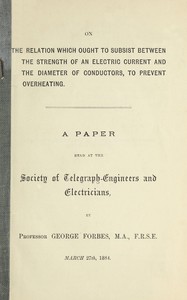
On the relation which ought to subsist between the strength of an electric…
Okay, so the title sounds like a dry scientific paper, but stick with me. This book is George Forbes's attempt to answer a very specific, practical question: How thick does an underwater telegraph cable need to be to actually work? That's it. That's the whole plot. In the late 1800s, laying a cable across the Atlantic was a colossal gamble. Too thin, and the signal dies. Too thick, and the ship can't carry it, sinking the company's finances. Forbes, who worked on these projects, breaks down the physics of signal loss and material strength into clear, logical steps. He shows you the math, but he's always pointing back to the real wire, the real ocean, and the real cost.
Why You Should Read It
You should read it because it makes genius feel accessible. There's no grandstanding here. It's a masterclass in problem-solving. You see a brilliant mind chipping away at a huge obstacle with sheer, patient logic. It's also a snapshot of a turning point in history. You're witnessing the moment global communication became possible, not through magic, but through calculation. It gives you a deep appreciation for the invisible engineering in everything around us.
Final Verdict
Perfect for anyone fascinated by the history of technology, engineering, or the Victorian era. If you enjoy stories about how things actually get built, or if you've ever looked at a modern marvel and thought, 'How did they figure that out?', this is your book. It's a short, focused, and surprisingly human look at the birth of our connected world.
This work has been identified as being free of known copyright restrictions. Distribute this work to help spread literacy.
Lisa Walker
6 months agoAs someone who reads a lot, the depth of research presented here is truly commendable. Don't hesitate to start reading.
Matthew Harris
4 months agoAfter hearing about this author multiple times, it manages to explain difficult concepts in plain English. One of the best books I've read this year.
Aiden Robinson
11 months agoComprehensive and well-researched.
Ava Wright
1 year agoI have to admit, the pacing is just right, keeping you engaged. Truly inspiring.


Oliver Taylor
2 years agoWow.