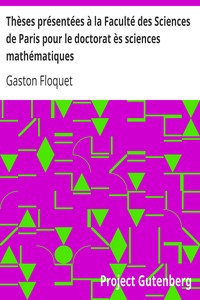
Thèses présentées à la Faculté des Sciences de Paris pour le doctorat ès…
Let's be clear: this isn't a novel. Thèses présentées à la Faculté des Sciences de Paris pour le doctorat ès… is Gaston Floquet's formal submission to earn his doctorate in 1883. The 'plot' is the journey of a mathematical argument. Floquet tackles a specific but powerful problem in differential equations: what happens when the coefficients in these equations are themselves periodic? His work leads to what we now call Floquet theory, a framework for understanding systems that repeat over time.
Why You Should Read It
You don't read this for character development. You read it to witness a foundational moment in math. There's a raw, pioneering energy here. Floquet isn't summarizing known facts; he's building a new tool from the ground up. It's like watching someone invent the wrench right before your eyes, knowing it will be used to build skyscrapers. The prose is dense and technical, but the intellectual clarity is stunning. For a math-minded reader, there's genuine suspense in following his logical steps to that final, elegant conclusion.
Final Verdict
This is a specialist's book, but its appeal can be wider. It's perfect for students of math or physics history who want to see the origin story of a key theory. It's also for anyone who appreciates primary sources and the unvarnished texture of real academic work from another century. You won't get a narrative, but you will get a direct line to a clever, systematic mind at work. Think of it as the academic equivalent of an artist's very first sketch for a masterpiece.
This historical work is free of copyright protections. Access is open to everyone around the world.