1

The Declaration of Independence of the United States of America — A Reader’s Guide
(0 User reviews)
1035
Project Gutenberg
1971
Not confirmed
United States -- History -- Revolution, 1775-1783 -- Sources; United States. Declaration of Independence
Readers of public-domain and historical texts
Project Gutenberg digital edition
en
Edition facts
Words
4,959
Reading time
22 min
Text sections
1
The source record for The Declaration of Independence of the United States of America — A Reader’s Guide measures this digital text at 4,959 words, 22 min estimated reading time, and 1 detected text section.
The text analysis averages about 27.0 words per sentence, while the detected sections provide another way to judge how the source is divided.
Project Gutenberg metadata also associates the work with “United States -- History -- Revolution, 1775-1783 -- Sources,” connecting these edition facts with the source record’s subject description.
Source:
Project Gutenberg record #1
An editorial note on Thomas Jefferson's diction, sentence structure, and rhetorical choices in the Declaration of Independence, drawing on the original text and its Project Gutenberg transcription history.
Read the complete public-domain text at its original source.
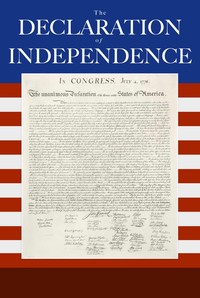
Read on Project GutenbergThe Declaration of Independence opens with a single, sweeping sentence that establishes both a philosophical premise and a legal argument. Jefferson's diction is notably abstract in the preamble—"the Laws of Nature and of Nature's God"—before shifting to concrete grievances. The Project Gutenberg transcription, produced in 1971 from all-caps computer output, preserves the text's original spelling variations, such as "Brittish" in the parchment facsimiles, which later editors corrected. This edition includes images of Jefferson's handwritten drafts, allowing comparison of his revisions.
Parallel Structure and Cumulative Force
Jefferson builds his case through anaphora and parallel clauses. The list of grievances against King George III is structured as a series of "He has" statements, each beginning with the same pronoun to emphasize the monarch's repeated abuses. For example, "He has refused his Assent to Laws" and "He has forbidden his Governors to pass Laws" create a rhythmic accumulation of evidence. This rhetorical device, common in legal and political writing of the era, transforms a list into a persuasive crescendo. The syntax mirrors the Enlightenment belief in orderly, reasoned argument, with each clause adding weight to the final conclusion.
Shifts in Register: From Philosophy to Indictment
The document moves between two distinct registers. The preamble employs elevated, abstract language: "all men are created equal," "unalienable Rights," "Life, Liberty and the pursuit of Happiness." These phrases derive from John Locke but are condensed into memorable, almost aphoristic form. In contrast, the grievances are concrete and legalistic, citing specific acts: "quartering large bodies of armed troops among us," "cutting off our Trade with all parts of the world." This shift from general principle to particular accusation strengthens the argument by grounding abstract rights in tangible violations. Jefferson avoids emotional language in the grievances, letting the facts speak through precise, unadorned prose.
The Role of the Passive Voice and Collective Agency
Jefferson strategically uses passive constructions to frame colonial actions as responses to tyranny. The phrase "it becomes necessary for one people to dissolve the political bands" places the focus on the necessity rather than the actors. Similarly, "a decent respect to the opinions of mankind requires that they should declare the causes" emphasizes obligation over volition. When the active voice appears, it is reserved for the king's actions: "He has plundered our seas, ravaged our Coasts, burnt our towns." This contrast subtly assigns agency: the king acts; the colonists react. The final paragraph shifts to first-person plural—"We, therefore, the Representatives of the united States of America"—asserting collective authority after the long indictment.
Variations in Punctuation and Capitalization Across Editions
The Project Gutenberg transcription notes that "even 'facsimiles' of the Declaration of Independence are nary identical to the original, nor of other 'facsimiles.'" This edition reproduces the text with original spellings like "Brittish" and inconsistent capitalization (e.g., "Laws" vs. "laws"). Jefferson's handwritten drafts, included as images, show further differences: he capitalized "Nature" and "God" but not always "Rights." The transcription also omits the names of signers, focusing solely on the text. Readers comparing the parchment facsimiles with Jefferson's drafts will notice variations in punctuation—commas added or removed—that affect the rhythm of the sentences. These discrepancies highlight the instability of even canonical documents and the editorial choices involved in reproducing them.
This edition offers a unique opportunity to examine the Declaration not only as a political document but as a crafted piece of prose. The inclusion of Jefferson's handwritten drafts and the transcription history invites readers to consider how textual variations shape meaning. Pay attention to the balance between abstract principle and specific grievance, and note how sentence length and structure guide the argument from philosophy to action.
I remember sitting on a porch in July, reading the Declaration’s long, winding sentences and thinking how Jefferson argued with the whole world in his head. That same quiet intensity came back to me with Fighting France, from Dunkerque to Belfort, where another writer tried to hold chaos still with words alone. Fighting France, from Dunkerque to Belfort — Reading Notes felt like a different kind of declaration—less about founding, more about enduring.
There are no reviews for this eBook.
There are no comments for this eBook.
Reader reflection
How did this book work for you?
Your answers remain private and are stored only in this browser.
Your progress
0
/
10
2
How much did you enjoy the reading experience?
3
Would you recommend this book to another reader?
4
How much effort did this book require?
5
Would a second reading be valuable?
6
Did the book deliver what you hoped for?
7
Which aspect of the book did you value most?
8
Did the book offer a fresh perspective?
9
What is the main idea you are taking away?
10