1

The Revolutions of Portugal — Themes and Context
(0 User reviews)
2971
Project Gutenberg
2013
Not confirmed
Portugal -- History -- Modern, 1580-; Portugal -- History -- Revolution, 1640
Readers of public-domain and historical texts
Project Gutenberg digital edition
en
Edition facts
Words
41,347
Reading time
180 min
Text sections
6
The catalog record for The Revolutions of Portugal — Themes and Context provides practical reading context through 41,347 words, 3 hr estimated reading time, and 6 detected text sections.
The text analysis averages about 35.8 words per sentence, while the detected sections provide another way to judge how the source is divided.
Project Gutenberg metadata also associates the work with “Portugal -- History -- Modern, 1580-,” connecting these edition facts with the source record’s subject description.
Source:
Project Gutenberg record #43852
An 18th-century English translation of Abbé de Vertot's history of the 1640 Portuguese revolution, focusing on the conspiracy that placed the Duke of Braganza on the throne. The translator's dedication to the Duke of Wharton reveals contemporary political alignments, while the narrative details the new king's cautious patronage and the lingering threat of Spanish loyalists.
Read the complete public-domain text at its original source.
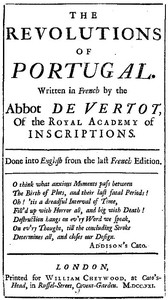
Read on Project GutenbergThe 1721 English edition of Abbé de Vertot's The Revolutions of Portugal opens not with the Portuguese rebellion but with a fulsome dedication to Philip, Duke of Wharton, a prominent British politician. Translator Gabriel Roussillon defends his 'incorrect' work and praises Wharton's 'Passion for Liberty' and 'Desire of doing Good to Mankind,' framing the history as politically resonant for an English audience. This paratext immediately signals that the volume is as much a piece of early 18th-century political positioning as a historical account.
A Conspiracy of Patronage and Prudence
The excerpted narrative centers on the aftermath of the 1640 coup that placed the Duke of Braganza on the Portuguese throne. Vertot describes how the new king, having been acknowledged by the States of the Kingdom, carefully managed rewards: he promoted conspirators of suitable birth but conspicuously overlooked Pinto, a servant of 'mean Extraction,' despite his crucial role. The king feared his royalty was not yet secure enough to elevate a low-born confidant. Yet Pinto retained informal authority, enjoying 'such entire Confidence' from his master. This detail illustrates the tension between rewarding loyalty and maintaining aristocratic hierarchies—a recurring theme in Vertot's account of consolidating power.
Foreign Alliances and Domestic Threats
Vertot depicts the new regime's dual strategy: securing foreign alliances while suppressing internal dissent. The king made 'a League offensive and defensive with the Dutch,' sought French protection, and sent ambassadors across Europe. Simultaneously, he attempted to persuade the Duke of Medina Sidonia, Governor of Andalusia, to rebel against Spain. Yet the narrative also highlights the persistent danger from Spanish loyalists within Portugal. The Archbishop of Braga, 'wholly devoted to the King of Spain,' feared that the new monarch might eventually imprison him. This juxtaposition of international diplomacy and court intrigue gives the history a layered, suspenseful quality, as the king's position remains precarious despite initial successes.
The Translator's Political Lens
Gabriel Roussillon's dedication to the Duke of Wharton is more than conventional flattery. He praises Wharton's 'Contempt of Power and Grandeur,' 'Love for your Country,' and 'Passion for Liberty'—terms that echo the revolutionary rhetoric of the Portuguese uprising. By linking Wharton to the Portuguese rebels, Roussillon implicitly casts the translation as a commentary on contemporary British politics, perhaps appealing to Whig sensibilities. The dedication also reveals the translator's anxiety about criticism, noting that this is 'not the first time of this Excellent Author's appearing in English,' and that his 'Undertaking must expose me to abundance of Cavil.' This self-consciousness frames the historical work as a politically charged document, not a neutral chronicle.
Readers should approach this text as a layered artifact: a translation of a French history of Portuguese rebellion, packaged for an English audience with a politically pointed dedication. The excerpts show Vertot's focus on the mechanics of conspiracy and the delicate balance of reward and exclusion. Pay attention to how the translator's framing shapes the narrative's reception, and note that the full work likely extends these patterns of cautious statecraft and hidden influence.
In old Vertot’s pages, one feels the quiet patience of a throne waiting through conspiracy and cautious patronage. That same slow perseverance, the holding of breath across decades, lingers in Harper's Pictorial Library of the World War, Volume XII — Background and Themes, where nations, too, endure long preparation before their own revolution’s dawn. Two histories, each whispering of endurance behind closed doors.
There are no reviews for this eBook.
There are no comments for this eBook.
Reader reflection
Before you leave, reflect on the book
Use these questions to collect your thoughts before moving on.
Your progress
0
/
10
2
How much did you enjoy the reading experience?
3
Is this a title you would suggest to others?
4
How demanding did the text feel?
5
How valuable was this book for your own interests?
6
Would a second reading be valuable?
7
How closely did the book connect with your experience?
8
Did the book offer a fresh perspective?
9
What is the main idea you are taking away?
10