1

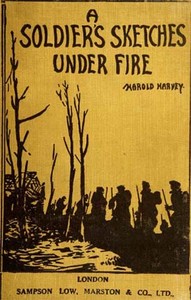
A Soldier's Sketches Under Fire — Inside the Classic
(0 User reviews)
3549
Project Gutenberg
2005
Not confirmed
World War, 1914-1918 -- Personal narratives, English; World War, 1914-1918 -- Pictorial works
Readers of public-domain and historical texts
Project Gutenberg digital edition
en
Edition facts
Words
17,750
Reading time
78 min
Text sections
2
The source record for A Soldier's Sketches Under Fire — Inside the Classic measures this digital text at 17,750 words, 1 hr 18 min estimated reading time, and 2 detected text sections.
The text analysis averages about 22.8 words per sentence, while the detected sections provide another way to judge how the source is divided.
Project Gutenberg metadata also associates the work with “World War, 1914-1918 -- Personal narratives, English,” connecting these edition facts with the source record’s subject description.
Source:
Project Gutenberg record #16056
Harold Harvey's firsthand sketches and notes from WWI trenches, blending visual record with wry anecdotes of makeshift telephones, chicken hunts, and a French comedian, revealing the ordinary soldier's resourceful humor amid danger.
Read the complete public-domain text at its original source.
Read on Project GutenbergHarold Harvey's A Soldier's Sketches Under Fire is not a conventional war memoir but a collection of annotated drawings made on the spot, often while under fire. The forenote stresses that these are not 'faked pictures' but sketches taken 'by a hand that had momentarily laid down a rifle.' Harvey himself admits he could not draw during charges or repulsions because he was taking part in them. This limits the scope to quieter, more observant moments—yet those moments are charged with the particular texture of trench life.
The catalog subjects list 'Personal narratives, English' and 'Pictorial works,' but the excerpts show a work that is neither purely textual nor purely visual: the drawings are absent from this digital edition, leaving only the written notes. These notes, however, carry their own vividness, recording improvised inventions, scavenged comforts, and the absurdity of daily survival.
Improvisation and the Listening Post
One of the most striking episodes describes the 'Seventy-five Hotel,' a former estaminet that received seventy-five shells in seventy-five minutes. The soldiers found a dinner bell in the cellar and turned it into an alarm system: a string connected the bell to the wrists of men in the listening post. A gentle pull would tinkle the bell, and word would pass along the trench. This improvised telephone is typical of the resourcefulness Harvey records—not grand strategy, but small, clever adaptations to constant threat.
The detail is precise: the bell was heard by companions, not by the enemy; the string was pulled at any sign of approach. Harvey does not dramatize the danger; he simply notes the system worked. The listening post itself, a forward position where men kept watch at night, is mentioned without elaboration, as if its peril was too routine to remark upon.
Feathers and Fowl: The Chicken Farm
At 'Chicken Farm,' the soldiers found two hundred and fifty chickens parading near the trench. Catching them was 'good sport,' eating them 'something finer'—a change from bully beef and biscuit. Harvey describes the cooking as 'prehistoric,' and the aftermath left the mud covered with feathers, sticking to wet uniforms and turning the men into 'Zulus, wild men, or Chippeway Indians.'
The humor is understated but unmistakable. The enemy, too, had a poultry farm and a portable kitchen; Harvey notes that German officers' uniforms were hung out to dry over a stove, making 'a lovely target.' Shooting at uniforms became a 'pleasant diversion.' This casual treatment of violence—target practice on laundry—reveals how the absurd and the lethal coexisted.
A French Comedian and the Mouth-Organ Band
Later, the battalion encountered a French civilian left behind by his regiment, a 'born comedian' who had stayed because 'the magnet of life-long associations held him to it.' He guided them to cottages still inhabited, tipped them off to cheap beer, and performed imitations of Harry Fragson to a mouth-organ band. He wore German jack-boots far too large for him, and his refrain was: 'Ze Engleesh soldier—très bon—ze French soldier—bon—mais ze Allemand—no bon!'
Harvey presents this figure without sentimentality. The man is useful, amusing, and slightly absurd in his oversized boots. The concerts, the mouth-organ band, the mimicry—these are the entertainments of men waiting. The comedian's broken English and patriotic hierarchy of soldiers are recorded as a matter of fact, not as a moral lesson.
Harvey's notes are deliberately modest, as he says, 'presented only for what they are.' Readers should approach this book as a fragmentary record: the drawings are absent, but the written observations stand on their own. The value lies not in a complete narrative of war but in the specific, unsentimental details—a dinner-bell telephone, a feather-covered trench, a comedian in oversized boots. These are the moments that official histories omit.
Reading Harvey’s chicken hunts, I remembered my grandfather’s quiet laugh about the absurdity of war—how a borrowed phone line mattered more than the mud. His old copy of Slavery and four years of war — Themes and Context held the same stubborn warmth, glimpses of ordinary people holding onto humor while the world cracked. That feeling stays with me.
There are no reviews for this eBook.
There are no comments for this eBook.
Reader reflection
Before you leave, reflect on the book
Use these questions to collect your thoughts before moving on.
Your progress
0
/
10
2
What was your overall reaction to the book?
3
Would you encourage someone else to read it?
4
What was the reading difficulty like?
5
Did any part of the book stay with you emotionally?
6
Did the book meet your expectations?
7
Did the story or argument move comfortably?
8
How personally connected did you feel to the book?
9
What did this book teach you most?
10