1

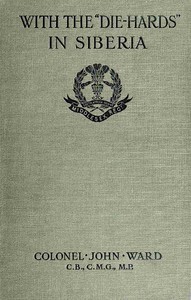
With the "Die-Hards" in Siberia — Reading Notes
(0 User reviews)
853
Project Gutenberg
2004
Not confirmed
World War, 1914-1918 -- Personal narratives, English; World War, 1914-1918 -- Russia (Federation) -- Siberia
Readers of public-domain and historical texts
Project Gutenberg digital edition
en
Edition facts
Words
75,440
Reading time
328 min
Text sections
8
The source record for With the "Die-Hards" in Siberia — Reading Notes measures this digital text at 75,440 words, 5 hr 28 min estimated reading time, and 8 detected text sections.
The text analysis averages about 26.1 words per sentence, while the detected sections provide another way to judge how the source is divided.
Project Gutenberg metadata also associates the work with “World War, 1914-1918 -- Personal narratives, English,” connecting these edition facts with the source record’s subject description.
Source:
Project Gutenberg record #10972
Colonel John Ward's firsthand account of the Allied intervention in Siberia, written originally for his sons, reveals the political infighting and broken promises among the Allies and Russian factions, as seen through the eyes of a British commander.
Read the complete public-domain text at its original source.
Read on Project GutenbergColonel John Ward frames his narrative not as a formal history but as a private record, originally written for his sons in case he did not return. This origin shapes the text's direct, unvarnished tone. Ward repeatedly emphasizes that the Allies' failure to support Admiral Koltchak with promised recognition and aid doomed the anti-Bolshevik cause. He writes that had those promises been kept, a Constituent Assembly might have been sitting in Moscow. The excerpts show a commander frustrated by Allied jealousy and indecision, particularly between British and French approaches, and by the Japanese representative's suspicious inquiries about exiled Social Revolutionaries.
A Private Record Turned Public Account
Ward states plainly that his account was originally written for his sons, not for publication. This private origin explains the memoir's candid, sometimes bitter tone. He acknowledges that later events proved some of his contemporary judgments wrong, but he chose not to revise the text, arguing that doing so would destroy its main value. The reader encounters a document that preserves immediate reactions and motives, not a polished retrospective. Ward's preface insists that statesmen and soldiers rarely write history—they make it—and that it is easy to be a prophet after the fact. This framing invites the reader to treat the narrative as a primary source of perceptions and frustrations, not as an objective chronicle.
Allied Discord and Russian Armies
The excerpts reveal deep fractures among the Allied powers. Ward reports that French obstruction prevented General Knox from organizing and equipping the Russian forces, so the Omsk Government raised its own army of over 200,000 men. When General Ganin arrived with Allied orders to take command, the Omsk Government refused, arguing that it would be derogatory to place a Russian army under a non-Russian officer. Ward was consulted and records the government's reasoning verbatim. He also notes that General Bolderoff, after conferring with the Czech National Council, returned to Omsk and refused a post, saying he did not believe a dictatorship could help Russia. These episodes illustrate the tangled chain of command and the conflicting national interests that hampered the intervention.
Japanese Interests and the Semianoff Affair
Ward's account includes specific incidents that point to Japanese ambitions. The Japanese representative at Omsk demanded to know whether General Bolderoff had been forced to leave the country, and also asked whether the British Army had supplied the train and guard that took exiled Social Revolutionary members of the Directorate to Chang-Chun. Ward notes that this question was not answered definitely, and he interprets Japanese interest in these men as evidence that the coup d'état had upset Japanese plans for occupying the Urals. He further records that General Semianoff, whose headquarters were alongside the Japanese at Chita, sent insolent refusals to recognize the Supreme Governor's orders. These details show how local commanders could defy central authority with foreign backing.
Readers should approach Ward's narrative as a participant's testimony, not a comprehensive history. His focus on Allied policy failures and internal Russian disputes reflects the limited perspective of a British commander on the ground. The excerpts do not cover the full scope of the Siberian intervention, but they offer a vivid, opinionated record of the political maneuvering that Ward believed doomed the anti-Bolshevik cause. Those interested in the Allied intervention will find here a candid, if partial, account of why promises were made and broken.
Colonel Ward wrote for sons who might not return, pressing pain into ink for strangers to read later. His book sits beside another I’ve shelved for years, one that waits at home for word from the front. Their kinship is quiet—both knowing that loving someone means enduring the empty chair. The Next of Kin: Those who Wait and Wonder — Key Ideas to Explore holds that same patient ache.
There are no reviews for this eBook.
There are no comments for this eBook.
Reader reflection
Before you leave, reflect on the book
Use these questions to collect your thoughts before moving on.
Your progress
0
/
10
2
How much did you enjoy the reading experience?
3
How likely are you to recommend this book?
4
How much effort did this book require?
5
Did any part of the book stay with you emotionally?
6
Was the book easy to understand?
7
Did you relate to its people, ideas, or situations?
8
How would you rate its originality?
9
What did this book teach you most?
10