1

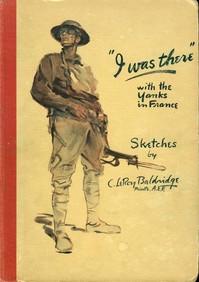
"I was there" with the Yanks on the western front, 1917-1919 — Reading Companion
(0 User reviews)
87
Project Gutenberg
2005
Not confirmed
World War, 1914-1918 -- Poetry; World War, 1914-1918 -- Pictorial works
Readers of public-domain and historical texts
Project Gutenberg digital edition
en
Edition facts
Words
7,264
Reading time
32 min
Text sections
3
The catalog record for "I was there" with the Yanks on the western front, 1917-1919 — Reading Companion provides practical reading context through 7,264 words, 32 min estimated reading time, and 3 detected text sections.
The text analysis averages about 21.8 words per sentence, while the detected sections provide another way to judge how the source is divided.
Project Gutenberg metadata also associates the work with “World War, 1914-1918 -- Poetry,” connecting these edition facts with the source record’s subject description.
Source:
Project Gutenberg record #15937
A soldier-artist's sketches and a doughboy's verse combine in this 1919 collaboration, capturing American troops in France from training camps to the Argonne, with candid observations of mud, rations, and fleeting human connections.
Read the complete public-domain text at its original source.
Read on Project GutenbergThis volume pairs the on-the-ground drawings of C. LeRoy Baldridge, a private in the American Expeditionary Forces, with the verse of Hilmar R. Baukhage, also a private. Baldridge’s sketches were made during a year with the French army in the Chemin-des-Dames sector and another year with the A.E.F. on special duty for The Stars and Stripes. The book’s title, I Was There, signals a first-hand, unglamorous perspective: the opening poem describes standing in line for “corned-willy, army fashion,” while the drawings show rain, mud, and tired soldiers. The work is neither a tactical history nor a patriotic tribute; it is a record of daily life, as Baldridge states, of “doughboy types” and the French civilians they lived among.
The Poet’s Voice: Grumbling and Endurance
Baukhage’s poems are written in a colloquial, often sardonic tone that matches the enlisted man’s perspective. In “The Line,” he catalogs the endless waiting: “For rice, pay-day, pills, and ration, / For corned-willy, army fashion.” The rhyme scheme is regular, but the content is gritty—mud, sweat, boredom. Another poem, “Equipment,” follows a soldier struggling under his pack: “My damn rifle and my helmet / Keep on getting in the way.” The language is direct, with mild profanity (“damn,” “hell”) that feels authentic rather than shocking. Baukhage does not glorify combat; he focuses on physical exhaustion and the absurdity of military routine. The poems are short, often narrative, and they complement the sketches by giving voice to the figures Baldridge drew.
The Artist’s Eye: Sketches of a War’s Edges
Baldridge’s drawings depict scenes that are rarely heroic: a soldier warming “corned willy” over solidified alcohol, a gas burn case being treated, a YMCA hut at Christmas. The captions are terse and specific: “Audsurade Belgium Nov. 11/1918” or “Outpost at Molsberg, Germany, an ancient castle.” He includes French civilians—Henri the shepherd, Jean who begs for “confiture Americaine,” Madelon who washes clothes. The sketches are not battle scenes; they show the spaces between offensives: loading parks, cellars used as shelters, a second-floor billet. Baldridge admits his “artistic skill has been so unequal to these opportunities,” but the drawings have a documentary value, capturing equipment, posture, and setting with a reporter’s eye. The mix of American and French subjects underscores the coalition nature of the war.
Contrasts in Tone and Subject
The book sets up deliberate tensions. The dedication poem addresses mothers: “Ours the Great Adventure, Yours the pain to bear,” but the poems and sketches undercut any romantic notion of adventure. Baukhage’s “Madelon” describes a brief, tender encounter with a French girl, yet the soldier leaves “like a brother” and shows her a photo from his shirt pocket—a moment of connection that is also a reminder of distance. Baldridge’s sketch of a “sixteen year old volunteer” stands next to one of an old couple’s “last war.” The visual and verbal records together create a layered portrait: the war is simultaneously a series of mundane chores (standing in line, eating cold rations) and a backdrop for fleeting human moments. The final images—troops coming home, reading the League of Nations draft—hint at an uncertain peace.
Readers should approach this book as a collaborative artifact, not a comprehensive history. The poems and sketches are best taken together: Baukhage’s words give interiority to the figures Baldridge drew, while the drawings ground the poems in specific places and objects. Because the excerpts are incomplete, the full range of the book’s content—especially later sections on the occupation of Germany—is not represented here. The work rewards attention to small details: a caption, a rhyme, a soldier’s posture. It is a record of what one artist and one poet saw, and chose to record, of their war.
This book’s mud-soaked sketch of a soldier fumbling with cold rations brought back my grandfather’s war diary, which I read one rainy afternoon. The Note-Book of an Attaché: Seven Months in the War Zone — The Note-Book of an Attaché: Seven Months in the War Zone — A Closer Reading carried that same ache, the quiet friction between duty and loneliness, as if both men had learned the identical hard grammar of waiting.
There are no reviews for this eBook.
There are no comments for this eBook.
Reader reflection
What was your reading experience?
Capture what you thought, learned, and would like to remember.
Your progress
0
/
10
2
Was reading this book enjoyable?
3
Is this a title you would suggest to others?
4
How much effort did this book require?
5
How would you describe its reading pace?
6
Do you expect to return to this book?
7
Would you like to discuss this book with someone?
8
What was the strongest part of the book?
9
What is the main idea you are taking away?
10