1

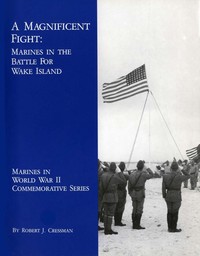
A Magnificent Fight: Marines in the Battle for Wake Island — Themes and Context
(0 User reviews)
84
Project Gutenberg
2015
Not confirmed
United States. Marine Corps -- History -- World War, 1939-1945; Wake Island, Battle of, Wake Island, 1941
Readers of public-domain and historical texts
Project Gutenberg digital edition
en
Edition facts
Words
25,967
Reading time
113 min
Text sections
18
Before opening A Magnificent Fight: Marines in the Battle for Wake Island — Themes and Context, the edition data offers a quick orientation: 25,967 words, 1 hr 53 min estimated reading time, and 18 detected text sections.
The text analysis averages about 19.9 words per sentence, while the detected sections provide another way to judge how the source is divided.
Project Gutenberg metadata also associates the work with “United States. Marine Corps -- History -- World War, 1939-1945,” connecting these edition facts with the source record’s subject description.
Source:
Project Gutenberg record #48810
Robert J. Cressman's pamphlet examines the Marine Corps' defense of Wake Island in December 1941, focusing on tactical decisions, weaponry, and individual actions under siege, based on official records and firsthand accounts.
Read the complete public-domain text at its original source.
Read on Project GutenbergRobert J. Cressman opens A Magnificent Fight not with a broad strategic overview but with a specific moment: the morning of 8 December 1941, when a Pan American Clipper takes off from Wake Island's lagoon, unaware that war has already begun. The narrative immediately narrows to the reactions of two officers—Major James P. S. Devereux and Commander Winfield S. Cunningham—as they receive word of the attack on Pearl Harbor. Cressman's prose is lean, favoring concrete details like the "sprung paper-clip" shape of the atoll and the precise time (0700) of the news. This opening establishes a pattern of grounding the reader in the sensory and chronological specifics of the siege, rather than in abstract strategic context.
Diction of Urgency and Understatement
Cressman's word choices consistently convey the pressure of combat without melodrama. When describing the first Japanese air raid, he writes that the antiaircraft fire "apparently forced them to bomb from a higher altitude than before (18,000 feet vice 13,000)." The clinical phrase "vice" (instead of) and the parenthetical altitudes reflect a reportorial tone that prioritizes factual precision. Elsewhere, a Marine's comment that "the bomb hitting the shelter was the only one close to the guns" is presented without editorializing, letting the understatement speak for itself. The author also uses verbs like "half runs, half walks" to capture physical strain, and phrases such as "a close thing" to echo the laconic speech of the Marines themselves. This diction—spare, exact, and occasionally colloquial—creates a sense of authenticity while avoiding the inflated rhetoric common in commemorative military writing.
Dialogue as Character and Tension
Cressman weaves quoted speech sparingly but effectively, using it to reveal personality and decision-making under fire. Major Devereux's reported words to his officers—that Wake "could expect the same thing in a very short time"—are direct and prophetic, establishing his no-nonsense command style. Later, a Marine gunner named Barninger writes after a near miss: "Although we didn't lose a man, it was a close thing and with the heavy caliber bombs the shelter is too light. For that reason we are all back in the foxholes." This passage, drawn from a letter or report, conveys practical judgment and a shift in tactics through the voice of a participant. Cressman also includes the terse radio messages sent by Cunningham to higher command, such as "All Hands Have Behaved Splendidly," which serve as both plot points and evidence of morale. The dialogue is never invented; it is always attributed to specific individuals, grounding the narrative in documented sources.
Structure: Chronology Interrupted by Sidebars
The pamphlet's organization is a deliberate blend of linear narrative and topical digressions. The main text proceeds day by day from 8 December through the surrender, but it is punctuated by sidebars—short, boxed sections on individuals (Major Putnam, Commander Cunningham) and equipment (the M3 antiaircraft gun, the 5-inch guns). These sidebars break the chronological flow to provide focused technical or biographical context. For example, a sidebar on "The Nells, Bettys, and Claudes of Japan" explains the aircraft types that appear in the narrative, while one on "The Defense Battalion's 5-Inch Guns" details the weaponry the Marines relied upon. This structure allows Cressman to maintain a tight chronological spine while still offering the reader necessary background without cluttering the main account. The effect is a hybrid of narrative history and reference work, suited to the pamphlet's commemorative purpose.
Recurring Details: The Physical Environment
Cressman repeatedly anchors the action in the atoll's geography and infrastructure. Wake Island is described as a "tiny sprung paper-clip"—a simile that emphasizes its small size and vulnerability. The narrative frequently mentions specific locations: Peacock Point, Camp 2, the lagoon, the contractor's cantonment. These place names accumulate, creating a mental map of the battlefield. The author also notes the physical condition of defenses—the "M-4 director" destroyed by a bomb but deflecting the explosion from an officer, the "shelter belonging to Barninger's no. 2 gun crew" whose sides were blown in. Such details ground the abstract concept of "siege" in tangible objects: foxholes, gun emplacements, damaged equipment. The repeated mention of "foxholes" as a preferred alternative to shelters after a near miss illustrates how the environment shaped tactics. This attention to the physical setting gives the reader a visceral sense of the cramped, exposed conditions under which the Marines fought.
Cressman's pamphlet is best read as a focused operational narrative rather than a comprehensive history. Readers should pay attention to the sidebars, which contain essential context for the equipment and personnel mentioned in the main text. The author's reliance on official reports and personal accounts means that the story is told largely from the American perspective; the Japanese side appears only through the lens of intercepted intelligence or observed actions. For those interested in the broader Pacific War, this work offers a detailed case study in small-unit defense against overwhelming odds, but it does not attempt to place Wake Island within the larger strategic picture of early 1942.
Reading about the quiet, dogged defiance at Wake Island, I keep thinking of another kind of resoluteness entirely. That siege feels so tangible, yet it stirs the same ache as something weightless—the aftermath of a different, older storm. Perhaps it’s the echo of survival under impossible odds. Both linger, soft as memory. I recalled Peaceless Europe — Text and Context, and how its shadows felt familiar.
There are no reviews for this eBook.
There are no comments for this eBook.
Reader reflection
What was your reading experience?
Capture what you thought, learned, and would like to remember.
Your progress
0
/
10
2
Did this book hold your interest?
3
Would you pass this book on to a friend?
4
What was the reading difficulty like?
5
How strongly did the book affect you emotionally?
6
Was the book moving at the right speed?
7
Did the book offer a fresh perspective?
8
Would a second reading be valuable?
9
What did this book teach you most?
10