1

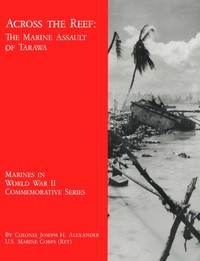
Across the Reef: The Marine Assault of Tarawa — Key Ideas to Explore
(0 User reviews)
115
Project Gutenberg
2015
Not confirmed
United States. Marine Corps -- History -- World War, 1939-1945; Tarawa, Battle of, Kiribati, 1943
Readers of public-domain and historical texts
Project Gutenberg digital edition
en
Edition facts
Words
32,791
Reading time
143 min
Text sections
23
Before opening Across the Reef: The Marine Assault of Tarawa — Key Ideas to Explore, the edition data offers a quick orientation: 32,791 words, 2 hr 23 min estimated reading time, and 23 detected text sections.
The text analysis averages about 17.6 words per sentence, while the detected sections provide another way to judge how the source is divided.
Project Gutenberg metadata also associates the work with “United States. Marine Corps -- History -- World War, 1939-1945,” connecting these edition facts with the source record’s subject description.
Source:
Project Gutenberg record #48836
Examines the November 1943 U.S. Marine assault on Betio Island, Tarawa Atoll, focusing on tactical decisions, leadership under fire, and the brutal realities of amphibious warfare against a fortified Japanese garrison.
Read the complete public-domain text at its original source.
Read on Project GutenbergJoseph H. Alexander’s account of the Tarawa assault opens not with the roar of naval guns but with a quiet, secret meeting in New Zealand. Vice Admiral Spruance informs Major General Julian C. Smith that the 2d Marine Division will target Betio Island, a tiny speck surrounded by a barrier reef. Lieutenant Colonel David Shoup studies a primitive chart and asks about experimental shallow-draft boats. “Not available,” Spruance replies. That exchange—between a planner’s foresight and the Navy’s limited resources—sets the tone for a narrative driven by the tension between doctrine and reality.
The Reef as a Tactical Problem
The barrier reef surrounding Betio is not merely a geographic detail; it becomes the central tactical puzzle of the operation. Alexander shows how the reef dictated the pace and cost of the assault. Standard wooden landing craft could not cross it at low tide, forcing Marines to wade hundreds of yards under fire. The text repeatedly returns to this obstacle: Shoup’s initial request for experimental boats, the later reliance on amphibian tractors (LVTs), and the deadly consequences when those tractors were destroyed or bogged down. The reef is a constant, unforgiving presence, shaping every decision from the planning table to the beach.
Fragmented Command and Improvised Leadership
Alexander’s narrative highlights how the chaos of battle forced ad hoc command structures. On D+1, Major Mike Ryan assembles a “makeshift battalion” on the western end of Betio, his fortunes hinging on three developments: the absence of a Japanese counterattack, the repair of a single tank, and the arrival of a naval gunfire spotter with a working radio. Elsewhere, Lieutenant Colonel Jordan merges his surviving 50 men with another unit and steps back to an observer role. These episodes reveal a battle where formal chains of command dissolve, and survival depends on local initiative and the ability to improvise with whatever resources—or luck—present themselves.
The Human Cost of Close Combat
The excerpts convey the brutality of fighting at close quarters through specific, unflinching details. Lieutenant William Hawkins, leading the Scout-Sniper Platoon, crawls up to a pillbox, fires through the gun ports, and throws grenades inside. He is shot in the chest but continues, taking out three more positions before a shell kills him. Colonel Shoup later says, “It’s not often that you can credit a first lieutenant with winning a battle, but Hawkins came as near to it as any man could.” The text also records a moment when Colonel Crowe authorizes a destroyer to fire at a bunker only 50 yards ahead of his own men—a decision that results in “arms and legs and everything just go up like that.” These passages do not glorify; they document the extremity of the fighting.
Alexander’s narrative is built from the ground up: the voices of company commanders, the logistics of ammunition resupply under sniper fire, the repair of a single tank that shifts a sector’s fortunes. Readers will find a study not of grand strategy but of how a battle is actually fought—through fragmented communications, improvised tactics, and the endurance of individuals in a landscape of coral, sand, and steel.
I remember the Tarawa volumes on the shelf, young men pitching from landing craft into that terrible surf. Years later, reading The Seventeenth Highland Light Infantry (Glasgow Chamber of Commerce Battalion) — Themes and Context, I found the same quiet endurance—ordinary boys from Glasgow streets, tested beyond measure. Both books whisper of courage paid in full, and I keep them side by side. The Seventeenth Highland Light Infantry (Glasgow Chamber of Commerce Battalion) — Themes and Context holds that kinship for me.
There are no reviews for this eBook.
There are no comments for this eBook.
Reader reflection
What was your reading experience?
Capture what you thought, learned, and would like to remember.
Your progress
0
/
10
2
Did this book hold your interest?
3
Would you pass this book on to a friend?
4
How easy was the book to follow?
5
Did any part of the book feel personally relevant?
6
How did the reading compare with what you expected?
7
Would a second reading be valuable?
8
Which part made the strongest impression?
9
What changed or sharpened your thinking?
10