1

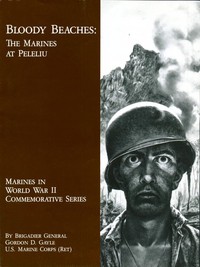
Bloody Beaches: The Marines at Peleliu — Edition Insights
(0 User reviews)
491
Project Gutenberg
2015
Not confirmed
United States. Marine Corps -- History -- World War, 1939-1945; Peleliu, Battle of, Palau, 1944; World War, 1939-1945 -- Campaigns -- Palau -- Peleliu Island
Readers of public-domain and historical texts
Project Gutenberg digital edition
en
Edition facts
Words
27,512
Reading time
120 min
Text sections
26
Before opening Bloody Beaches: The Marines at Peleliu — Edition Insights, the edition data offers a quick orientation: 27,512 words, 2 hr estimated reading time, and 26 detected text sections.
The text analysis averages about 20.6 words per sentence, while the detected sections provide another way to judge how the source is divided.
Project Gutenberg metadata also associates the work with “United States. Marine Corps -- History -- World War, 1939-1945,” connecting these edition facts with the source record’s subject description.
Source:
Project Gutenberg record #49032
An editorial note examining Brigadier General Gordon D. Gayle's authorial choices in diction, dialogue, and description within his account of the Peleliu campaign, focusing on how language conveys command decisions, tactical assumptions, and the brutal reality of the battle.
Read the complete public-domain text at its original source.
Read on Project GutenbergBrigadier General Gordon D. Gayle opens Bloody Beaches: The Marines at Peleliu with a precise, almost clinical description of the assault: five infantry battalions crossing 600–800 yards of coral reef toward five selected landing beaches. The specificity of numbers and the passive construction—'were told that their commanding general... believed'—immediately establish a tone of detached military reporting. Yet the text is punctuated by moments of stark imagery, such as the caption quoting Tom Lea: 'His jaw hung, and his eyes were like two black empty holes in his head.' This juxtaposition of operational detail with visceral human cost is a deliberate authorial choice, reflecting Gayle's dual role as a participant and historian.
Diction of Command: Certainty and Its Costs
Gayle's choice of verbs and modifiers reveals the tension between expectation and reality. He writes that General Rupertus 'clung to a belief' that his Marines could prevail without Army help, and that he 'continued to exhort his commanders to hurry up.' The word 'clung' suggests desperation, while 'exhort' implies a persistent, almost futile urging. Similarly, when describing the prelanding scheme, Gayle notes that 'such thinking may have been consistent with Rupertus' prediction of a three-day assault.' The hedging phrase 'may have been' subtly undercuts the general's confidence. These linguistic cues, drawn from official records and interviews, allow Gayle to critique command decisions without overt judgment, letting the diction imply the disconnect between planning and reality.
Dialogue as Evidence of Disagreement
Gayle incorporates reported speech to highlight internal dissent. Colonel 'Bucky' Harris's suggestion that commanders view the Umurbrogol Pocket from light planes is met with dismissal: 'Both Puller and Rupertus responded to Harris that they had their maps.' The bluntness of this reply, preserved in the narrative, underscores a refusal to adapt. Gayle also recounts Harris's own aerial reconnaissance, which 'altered his view... from sober to grave.' The progression from 'sober' to 'grave' is a careful lexical choice, showing how firsthand observation shifted a commander's assessment. By including these exchanges, Gayle demonstrates that dialogue—even paraphrased—serves as evidence of the friction between field experience and headquarters assumptions.
Description of Terrain and Tactical Assumptions
The physical environment on Peleliu is rendered through functional, almost technical description: 'sinkholes and difficult terrain much as pictured here.' Yet Gayle also employs metaphor, comparing Marines to 'fish in a barrel' when Japanese soldiers fired from caves and heights. This simile, drawn from a contemporary account, crystallizes the tactical disadvantage. The author further notes that the prelanding plan 'reflected a series of four west-to-east phase lines, indicating an expected linear advance.' The phrase 'expected linear advance' contrasts sharply with the reality of the Umurbrogol Pocket, where terrain negated linear thinking. Gayle's descriptive choices—alternating between map-like precision and stark imagery—underscore how the landscape itself defied the planners' conceptual framework.
Structure and the Weight of Chronology
Gayle organizes the narrative chronologically, but he interrupts the sequence with sidebars on Japanese tactics, naval gunfire, and Tom Lea's paintings. This structural choice mirrors the way operational planning was interrupted by unforeseen developments. For instance, the sidebar 'A Horrible Place' appears early, foreshadowing the grim conditions. The author also includes a table of distances from Peleliu to various Pacific locations, grounding the battle in a broader geographic context. By weaving sidebars into the main text, Gayle replicates the layered complexity of command, where tactical decisions were constantly informed by logistical, strategic, and human factors. The chronology itself becomes a tool to show how delays—like the commitment of reserves to Ulithi—compounded the struggle.
Gayle's account rewards readers who attend to the interplay between official reports and personal testimony. The sidebars and quoted exchanges offer windows into the decision-making process, while the descriptive passages ground abstract strategy in physical reality. Readers may find it useful to track how Gayle signals his own assessments through subtle word choices—such as 'clung,' 'exhort,' and 'grave'—rather than explicit commentary. This approach makes Bloody Beaches not only a record of events but also a study in how military history is shaped by the language of its narrators.
Reading about Gayle’s spare language on Peleliu, I remembered my grandfather’s silence after the war—how he never described the coral, only the heat. That restraint felt familiar, like the quiet dread in A Kut Prisoner — Background and Themes, where survival isn’t dramatized, just endured. Both books taught me that sometimes the most honest telling is the one that leaves the worst unsaid.
There are no reviews for this eBook.
There are no comments for this eBook.
Reader reflection
Record your reading impressions
A brief reflection can help important ideas stay with you longer.
Your progress
0
/
10
2
What was your overall reaction to the book?
3
How likely are you to recommend this book?
4
How easy was the book to follow?
5
How useful did the reading feel?
6
How well did it match your expectations?
7
Was the book easy to understand?
8
Did you relate to its people, ideas, or situations?
9
In one sentence, what did you learn?
10