1

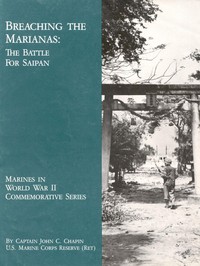
Breaching the Marianas: The Battle for Saipan — Reading Companion
(0 User reviews)
1497
Project Gutenberg
2015
Not confirmed
United States. Marine Corps -- History -- World War, 1939-1945; World War, 1939-1945 -- Campaigns -- Northern Mariana Islands -- Saipan; Saipan -- History, Military
Readers of public-domain and historical texts
Project Gutenberg digital edition
en
Edition facts
Words
22,531
Reading time
98 min
Text sections
25
Breaching the Marianas: The Battle for Saipan — Reading Companion can be approached with a clearer sense of reading commitment from its source measurements: 22,531 words, 1 hr 38 min estimated reading time, and 25 detected text sections.
The text analysis averages about 20.0 words per sentence, while the detected sections provide another way to judge how the source is divided.
Project Gutenberg metadata also associates the work with “United States. Marine Corps -- History -- World War, 1939-1945,” connecting these edition facts with the source record’s subject description.
Source:
Project Gutenberg record #48899
A Marine Corps captain's account of the 1944 Battle for Saipan, based on official records and personal experience, focusing on tactical maneuvers, unit coordination, and the daily realities of combat.
Read the complete public-domain text at its original source.
Read on Project GutenbergJohn C. Chapin's account of the Battle for Saipan opens with a precise chronology: at 0542 on 15 June 1944, Vice Admiral Turner ordered the landing force ashore. The narrative immediately establishes a pattern of specific times, unit designations, and weapon calibers that persists throughout. Chapin, a Marine Corps captain who served in the battle, draws on both official records and his own experience, creating a text that moves between high-level command decisions and the intimate details of a junior officer's pre-sleep routine—checking his carbine, arranging grenades, and placing a combat knife within reach.
Catalog Subjects vs. Textual Evidence
The catalog lists three subjects: United States Marine Corps history, World War II campaigns in Saipan, and Saipan military history. The excerpts confirm these but also reveal a significant emphasis on inter-service friction. The text includes a sidebar for the Army 27th Infantry Division and describes its performance in pointed terms: the official Army account noted that attacks were “frequently uncoordinated” and units “repeatedly yielded ground they had gained.” Chapin reports that the division's colonel was relieved, along with nineteen other officers. This critical treatment of an Army unit goes beyond a straightforward Marine Corps history, suggesting the book engages with command controversies that the catalog subjects do not explicitly capture.
Structure as a Tactical Document
The book is organized by days (D+1, D+2, etc.) and includes sidebars on commanders, divisions, and Medal of Honor recipients. This structure mirrors a military after-action report, prioritizing chronological clarity and unit identification. The excerpts show that Chapin embeds personal recollection within this framework: his own memory of a nightly routine appears under the heading for D+11, sandwiched between accounts of the 27th Division's troubles and the 2nd Marine Division's advance on Garapan. This juxtaposition of official narrative and individual experience is a deliberate structural choice, allowing the reader to see both the operational picture and the human cost without editorial commentary.
Recurring Details of Terrain and Weaponry
Chapin repeatedly anchors his narrative in specific geographic features: Hell's Pocket, Death Valley, Purple Heart Ridge, Nafutan Point, Hill 500. These names recur across multiple days, giving the battle a tangible geography. Weaponry is cataloged with similar precision: 75mm guns on LVTs, 4.5-inch rockets, 37mm guns described as a “workhorse,” and the author's own carbine and combat knife. The text includes a photograph caption noting Japanese bullet holes in a 37mm gun shield. These details are not decorative; they serve as evidence of the material conditions of the battle, grounding the account in the physical realities that the catalog subject headings only imply.
Readers should note that the excerpts cover only the first half of the battle (through D+11) and include the book's front and back matter. The full text likely continues the day-by-day format through the end of the campaign on D+24 and includes a section on Saipan's legacy. Chapin's dual role as participant and historian means the narrative shifts between personal memory and official report; paying attention to these shifts reveals the book's distinctive perspective on command, unit performance, and the daily routines of combat.
There’s something about Captain’s account of Saipan—how he lingers on the quiet between maneuvers, the waiting—that reminds me of another war’s diary, where the stillness weighs even heavier. Both feel less like history and more like a held breath. It’s that pause I keep thinking about. My Diary in Serbia: April 1, 1915-Nov. 1, 1915 — Context and Discussion carries the same ache, the same ordinary moments made enormous. Strange how those small silences stay with you longest.
There are no reviews for this eBook.
There are no comments for this eBook.
Reader reflection
Take a moment to reflect on this book
Create a short personal record of your experience with this book.
Your progress
0
/
10
2
How much did you enjoy the reading experience?
3
Would you recommend this book to another reader?
4
How much effort did this book require?
5
Could you see yourself revisiting this book?
6
Could you apply anything you learned?
7
Did the book meet your expectations?
8
Did this book create an emotional response?
9
What changed or sharpened your thinking?
10