1

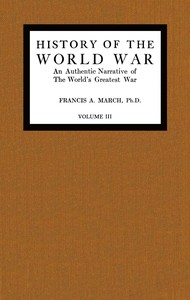
History of the World War — Edition Insights
(0 User reviews)
174
Project Gutenberg
2006
Not confirmed
World War, 1914-1918
Readers of public-domain and historical texts
Project Gutenberg digital edition
en
Edition facts
Words
241,279
Reading time
1050 min
Text sections
21
The catalog record for History of the World War — Edition Insights provides practical reading context through 241,279 words, 17 hr 30 min estimated reading time, and 21 detected text sections.
The text analysis averages about 21.1 words per sentence, while the detected sections provide another way to judge how the source is divided.
Project Gutenberg metadata also associates the work with “World War, 1914-1918,” connecting these edition facts with the source record’s subject description.
Source:
Project Gutenberg record #18993
An editorial note on how the opening, middle, and later excerpts of this 1918 narrative guide a first reading, focusing on the authors' voice, structure, and use of specific details like the Canadian trench raid and the Archangel campaign.
Read the complete public-domain text at its original source.
Read on Project GutenbergThe opening of History of the World War immediately establishes a dual perspective: the authors, Francis A. March and Richard J. Beamish, frame the conflict as a moral struggle against a foe that would “scientifically and in cold blood resort to poison gases.” This rhetorical stance, paired with a focus on Canada’s mobilization, sets a tone of righteous indignation and national sacrifice. The narrative quickly narrows to the Princess Patricia’s Canadian Light Infantry, a unit of “older men and most of them were married,” whose near-annihilation is presented as both exemplary and representative. This blend of broad condemnation and specific regimental history characterizes the book’s method throughout.
Voice and Moral Framing
The authors adopt a consistently elevated, patriotic tone. In the opening, Germany is described as acting “contrary to all accepted agreements of civilized countries,” a phrase that recurs in spirit across the narrative. This moral clarity is reinforced by the choice to highlight Canada’s “steeled” heart and determination to fight “with her last dollar and her last man.” The prose is declarative, often using superlatives: the Princess Patricia’s story is called “immortal,” and their deeds “of valor” are said to show “what it is possible for man to go through and live.” Such language signals that the book is not a dispassionate chronicle but a commemorative account, one that seeks to inspire as much as inform. Readers should expect this evaluative voice throughout, with battles and units judged by their contribution to the Allied cause and their demonstration of national character.
Structure: From General to Specific
The excerpts reveal a clear structural pattern: each major section opens with a broad strategic or political statement, then narrows to a particular unit or engagement. For example, after condemning German tactics, the text immediately turns to the Princess Patricia’s Canadian Light Infantry, detailing their composition, deployment, and reputation. Similarly, the discussion of the Canadian cavalry brigade and the battles of Festubert and Givenchy is preceded by a general note on the thinness of the British line in Flanders. This movement from the general to the specific helps readers grasp the larger context before diving into tactical details. It also allows the authors to weave together multiple scales of war—from imperial strategy to the experience of individual regiments—without losing coherence. First-time readers can use this pattern as a guide: when a new chapter or section begins, expect a broad claim followed by concrete examples.
Recurring Details: The Trench Raid and the Arctic
Two specific details stand out across the excerpts. First, the Canadian “trench raid” is described as a tactical innovation: “cutting off a section of enemy trench, killing or taking prisoners … destroying it and returning with little or no loss.” The authors note that this method was “quickly copied from one end of the Franco-British line to the other,” emphasizing its significance. Second, the later excerpt (from the transcriber’s note) mentions the Archangel campaign, where American troops fought Bolsheviks in subzero temperatures, with “little daylight for months.” While this section is not part of the main narrative, it hints at the book’s coverage of lesser-known fronts. Readers should watch for how the authors treat such innovations and peripheral theaters—whether they receive the same moral framing as the Western Front or are presented as anomalous episodes.
Limits of the Excerpts: What Remains Unclear
The excerpts cover only the early war (1914–1916) and a brief mention of 1918. The full book, at over 240,000 words, likely extends through the Armistice and includes postwar reflections. However, from the provided text, it is impossible to know how the authors handle the later years, the entry of the United States, or the war’s conclusion. The tone of the opening—righteous and nationalistic—may persist, or it may shift as the war drags on. Additionally, the excerpts focus heavily on Canadian forces; the book’s title promises a “world” history, but the balance between Allied nations is not evident here. Readers should approach the text aware that these excerpts represent only a fraction of the whole, and that the authors’ perspective may evolve or broaden in later chapters.
For a first reading, pay attention to how the authors balance moral argument with military detail. The book’s structure—moving from broad condemnation to specific unit histories—makes it accessible, but its patriotic lens means that strategic decisions and enemy actions are always filtered through a clear Allied viewpoint. The recurring emphasis on innovation, like the trench raid, and on sacrifice, as with the Princess Patricia’s, provides a thread that may run through the entire work. Let these elements guide your engagement with the text, but remain alert to shifts in tone or coverage as the narrative progresses beyond the early war years.
There’s something in how that 1918 narrative slows around the Canadian trench raid, almost like the author knew the war’s middle would blur. I found myself thinking of the Archangel campaign’s quiet strangeness, then remembered sitting with The U-boat hunters — A Reader’s Guide last winter, its own voice just as unhurried. These old books keep their own time, don’t they?
There are no reviews for this eBook.
There are no comments for this eBook.
Reader reflection
What did you think of this book?
Answer a few questions and save a private reflection on this device.
Your progress
0
/
10
2
What was your overall reaction to the book?
3
Would you recommend this book to another reader?
4
How demanding did the text feel?
5
Would a second reading be valuable?
6
What was the strongest part of the book?
7
Would this book work well in a reading group?
8
How did the pace of the book feel?
9
In one sentence, what did you learn?
10