1

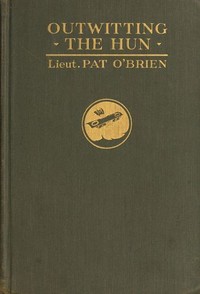
Outwitting the Hun: My Escape from a German Prison Camp — Story, Setting & Ideas
(0 User reviews)
209
Project Gutenberg
2013
Not confirmed
World War, 1914-1918 -- Prisoners and prisons, German; Prisoner-of-war escapes
Readers of public-domain and historical texts
Project Gutenberg digital edition
en
Edition facts
Words
59,077
Reading time
257 min
Text sections
6
The source record for Outwitting the Hun: My Escape from a German Prison Camp — Story, Setting & Ideas measures this digital text at 59,077 words, 4 hr 17 min estimated reading time, and 6 detected text sections.
The text analysis averages about 25.3 words per sentence, while the detected sections provide another way to judge how the source is divided.
Project Gutenberg metadata also associates the work with “World War, 1914-1918 -- Prisoners and prisons, German,” connecting these edition facts with the source record’s subject description.
Source:
Project Gutenberg record #42490
Lieutenant Pat O'Brien's 1918 memoir recounts his capture by German forces, imprisonment at Courtrai, and escape through enemy territory. The narrative shifts from aerial combat to tense, ground-level evasion, with O'Brien's direct, understated voice conveying both the physical ordeal and the psychological strain of passing through occupied Belgium.
Read the complete public-domain text at its original source.
Read on Project GutenbergLieutenant Pat O'Brien's account of his escape from a German prison camp is marked by a distinct shift in narrative pace and voice. The opening chapters, which describe his service in the Royal Flying Corps and his capture, move with the clipped, matter-of-fact tone of a military report. Once O'Brien is on the run, however, the prose slows to match the cautious, step-by-step progress of a fugitive. The reader is drawn into the same heightened awareness of every sound, shadow, and decision that O'Brien himself experienced.
The excerpt from his journey through Belgium illustrates this change: a simple walk toward a wood becomes a series of calculated risks. O'Brien notes the density of the population, the position of a police station, and the presence of two German soldiers leaning against a bicycle. His heartbeat, he writes, was so loud he feared the soldiers would hear it. Such details ground the escape in physical sensation rather than heroic posturing.
From Cockpit to Footpath: A Change in Tempo
The book's first chapters, covering O'Brien's training and aerial battles, are brisk and almost impersonal. He describes being “brought down and made prisoner” without elaboration, and the narrative moves quickly from one event to the next. This pace reflects the speed of air combat and the routine of military life. Once O'Brien escapes the camp at Courtrai, however, the rhythm alters dramatically. The sentences become shorter, the observations more granular. He notes the exact dimensions of a peasant's kitchen—“perhaps fourteen feet square”—and the size of a fireplace that took up eight feet of one wall. Such measurements are not decorative; they convey the cramped, exposed reality of hiding. The shift in tempo mirrors O'Brien's own transition from a pilot who moved through the sky to a man who must crawl through woods and decide whether to risk crossing a road in plain view of German soldiers.
The Voice of Understatement
O'Brien's narrative voice is consistently direct and understated, even in moments of extreme danger. He does not dramatize his fear but reports it plainly: “If anybody imagines, however, that I was at all comfortable as I approached those soldiers, he must think that I am a much braver man than I claim to be.” This self-deprecating honesty is a recurring feature. When an old woman who appears “close to a hundred” answers his knock and then calls for her husband in a “shrill voice that would have done credit to a girl of eighteen,” O'Brien records the detail without embellishment. The humor is dry and incidental, not forced. His voice remains that of a man who is observing his own predicament with a kind of wry clarity. This restraint makes the moments of tension—such as the approach to the German soldiers—all the more effective, because the reader trusts that O'Brien is not exaggerating.
The Landscape of Risk: Setting as Obstacle
The physical environment in O'Brien's account is never merely a backdrop; it is an active participant in the escape. Woods offer cover but also conceal railroad tracks and clearings that signal human habitation. Villages force detours that can double the distance traveled: “To gain a mile I would sometimes have to make a detour of two or three.” O'Brien's descriptions of the Belgian countryside are functional—he notes the density of population, the position of a police station by its red lights, the presence of peasants on the road—but they accumulate into a map of risk. Every decision about whether to skirt a village or walk through it carries the weight of potential betrayal. The landscape is not picturesque; it is a series of tactical problems. O'Brien's methodical attention to these details reveals a mind trained to assess and adapt, and the narrative gains its tension from the reader's awareness that one wrong turn could end the journey.
Readers approaching O'Brien's memoir should attend to the small decisions that structure the escape: when to hide, when to walk boldly, whom to trust. The narrative rewards careful reading of its practical details—the size of a room, the position of a soldier, the distance to a wood. O'Brien's voice, unadorned and occasionally wry, offers a perspective that is neither sensational nor detached. The book is best experienced as a record of sustained improvisation under pressure, told by a man who seems more interested in what he did than in how he felt about it.
Reading O'Brien's quiet terror crossing occupied Belgium, I kept thinking how war's edges blur—the same unease sat in those letters from the Marne, written before anyone knew what was coming. There's a strange companionship in that uncertainty. A Hilltop on the Marne Being Letters Written June 3-September 8, 1914 — Reading Companion felt like a whisper from a calmer hour, and it lingered with me just as softly.
There are no reviews for this eBook.
There are no comments for this eBook.
Reader reflection
What was your reading experience?
Capture what you thought, learned, and would like to remember.
Your progress
0
/
10
2
What was your overall reaction to the book?
3
How likely are you to recommend this book?
4
How much effort did this book require?
5
Did any part of the book stay with you emotionally?
6
How well did it match your expectations?
7
Did it raise ideas you would like to talk about?
8
How distinctive were its ideas or approach?
9
In one sentence, what did you learn?
10