1

Soldier silhouettes on our front — Key Ideas to Explore
(0 User reviews)
1574
Project Gutenberg
2006
Not confirmed
World War, 1914-1918 -- Personal narratives; World War, 1914-1918 -- War work -- Young Men's Christian Associations
Readers of public-domain and historical texts
Project Gutenberg digital edition
en
Edition facts
Words
37,480
Reading time
163 min
Text sections
5
Before opening Soldier silhouettes on our front — Key Ideas to Explore, the edition data offers a quick orientation: 37,480 words, 2 hr 43 min estimated reading time, and 5 detected text sections.
The text analysis averages about 19.5 words per sentence, while the detected sections provide another way to judge how the source is divided.
Project Gutenberg metadata also associates the work with “World War, 1914-1918 -- Personal narratives,” connecting these edition facts with the source record’s subject description.
Source:
Project Gutenberg record #18078
A YMCA worker's firsthand sketches of American soldiers in WWI France, structured as thematic 'silhouettes' that contrast moments of song, sacrifice, sorrow, and service against the backdrop of war.
Read the complete public-domain text at its original source.
Read on Project GutenbergWilliam L. Stidger organizes his wartime observations around the metaphor of silhouettes—figures thrown into relief against a luminous background. The book's chapter titles ("Silhouettes of Song," "Silhouettes of Sacrifice," etc.) signal a deliberate structure: each section isolates a single emotional or experiential register, much like a series of photographic plates. Stidger writes in the foreword that he aims to give "an accurate heart-picture" rather than a comprehensive portrait, and the episodic, vignette-driven form reflects this selective focus. The recurring image of light—sunset, searchlights, dawn—frames even the darkest scenes, as when he notes that "one cannot have silhouettes, even of sorrow, if there is no background of light and hope."
Thematic Grouping by Alliteration
The thirteen chapters are unified by a conspicuous alliterative pattern: nearly every title begins with the letter S (Song, Ship, Sacrifice, Spiritual, Sacrilege, Silence, Service, Sorrow, Suffering, Soldier, Sky, Sunshine). This device gives the book a mnemonic, almost liturgical rhythm, as if each chapter were a station in a procession. The alliteration also imposes order on chaotic experience—war's randomness is contained within a verbal frame. Notably, the pattern breaks in chapter XII, "The Lights of War," which shifts to a different initial sound, perhaps to mark a culminating or contrasting perspective. The consistency of the S-pattern elsewhere suggests Stidger crafted the sequence carefully, grouping episodes not by chronology but by emotional tone.
Movement Between Transport and Trench
The excerpts show a clear spatial progression: the first chapter places the reader on a transport ship "cutting its sturdy way" through storm and submarine danger, with the narrator on "aft fire-control" observing gunners. Later chapters move to French soil—train stations, cathedrals, hotel lobbies—and finally to aerial combat, as when a young aviator describes falling through the night. This trajectory from sea to land to sky mirrors the soldier's own journey from departure to deployment. Stidger anchors each scene with precise physical details: the "upturned roots of an old tree," the "great doors" of the Madeleine, the searchlight catching a plane. The movement is not linear but cumulative, each new setting adding a layer to the silhouette.
Recurring Image of Mothers and Farewells
A repeated motif is the mother sending her son to war. Stidger recounts a story brought back from Germany: a thousand mothers wave and smile as a troop train departs, then collapse in a "low moan" once the train is out of sight. He calls this "characteristic of the triumphant motherhood of the whole world." Later, he mentions an American mother who "sent her boy away smiling" and then "dropped dead on the station." The image recurs in the silhouette of a woman and child in black who visit the Madeleine daily to pray "for the other aviators." These vignettes share a structure—public composure giving way to private grief—and Stidger uses them to argue that sorrow is always "fringed with gold and silver." The repetition turns individual stories into a collective emblem.
The Silhouette as a Formal Principle
Stidger explicitly defines his method in the foreword: experiences "stand out like the silhouettes of mountain peaks against a crimson sunset." The silhouette requires a bright background to be visible, and throughout the book, light sources—sunset, searchlights, dawn—serve that function. In the chapter "Silhouettes of Sorrow," he writes that "even in war-time God 'still'" (the sentence breaks off in the excerpt), implying a theological backdrop. The illustrations by Jessie Gillespie, described in the captions ("The last seen of Dale he was gathering together a crowd of little children"), likely reinforce this visual metaphor. The structure thus mirrors its own title: each chapter is a dark shape held against a luminous field, and the reader is invited to see the soldier not as a full portrait but as a stark, memorable outline.
Stidger's book is best approached as a series of discrete impressions rather than a continuous narrative. Readers may find it useful to note how each chapter's title keyword (Song, Sacrifice, Sorrow) shapes the selection of anecdotes—and how the same image (a mother's farewell, a gunner on deck) can reappear in different tonal contexts. The silhouettes are deliberately incomplete; Stidger warns he has not attempted "the too great task of showing the soul of the soldier." Accepting that limitation allows the vignettes to work as they were intended: as heart-pictures, not histories.
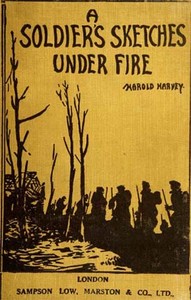
I have held both volumes close, and I remember how the silhouettes in that first one—their quiet songs and heavier sorrows—seemed to breathe. It felt like meeting an old friend’s diary. Then, years later, A Soldier's Sketches Under Fire — Inside the Classic came to my shelf, and I saw the same hands, the same patient ink, the same unspoken wish to be remembered. They keep each other company now.
There are no reviews for this eBook.
There are no comments for this eBook.
Reader reflection
Your personal reading reflection
Build a private reading journal entry for this title.
Your progress
0
/
10
2
Did this book hold your interest?
3
Would you recommend this book to another reader?
4
Did the language feel accessible?
5
How would you rate its originality?
6
How closely did the book connect with your experience?
7
How useful were the ideas in this book?
8
Did the story or argument move comfortably?
9
Which lesson or insight stayed with you?
10