1

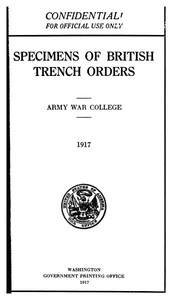
Specimens of British Trench Orders — Text and Context
(0 User reviews)
709
Project Gutenberg
2016
Not confirmed
World War, 1914-1918; Great Britain. Army; Intrenchments; Military orders
Readers of public-domain and historical texts
Project Gutenberg digital edition
en
Edition facts
Words
20,950
Reading time
92 min
Text sections
3
Before opening Specimens of British Trench Orders — Text and Context, the edition data offers a quick orientation: 20,950 words, 1 hr 32 min estimated reading time, and 3 detected text sections.
The text analysis averages about 17.5 words per sentence, while the detected sections provide another way to judge how the source is divided.
Project Gutenberg metadata also associates the work with “World War, 1914-1918,” connecting these edition facts with the source record’s subject description.
Source:
Project Gutenberg record #53126
A 1917 War Department publication compiling British trench orders from the Canadian Corps, detailing sentry duties, patrol protocols, and relief procedures with precise timing and hierarchical accountability.
Read the complete public-domain text at its original source.
Read on Project GutenbergThe document opens with a confidential classification and a War Department directive dated May 15, 1917, establishing its official purpose: to circulate British trench orders among U.S. forces. The contents are structured as numbered paragraphs under subject headings, beginning with Canadian Corps Trench Orders. The first section, 'Duties,' immediately establishes a rhythm of alternating day and night tours—two hours by night, four by day—with inclement weather reducing the span. This attention to temporal precision recurs throughout, as does the emphasis on verbal reporting: N.C.O.s report 'All correct' to the officer on duty, and sentries announce the same when an officer passes.
Temporal Rhythms and Duty Cycles
The orders are built around a strict schedule of rotation. Sentries are relieved every two hours, except in bad weather when the tour is shortened. The day begins and ends with 'stand to,' a term that appears repeatedly as a temporal anchor. Men are warned for duty at evening stand to, and the length of each tour depends on available personnel. This cyclical structure governs not only sentry posts but also working parties, patrols, and reliefs. The text specifies that no man who has worked during the day shall be placed on sentry without at least four hours of rest, unless unavoidable. Such rules reveal a system designed to manage fatigue under constant alert.
Hierarchy of Vigilance
Responsibility flows upward through a clear chain. The company commander sends reports to battalion headquarters unless something unusual occurs, in which case the officer on duty takes over. N.C.O.s post sentries and report to the officer on duty. Sentries themselves are to be posted by an N.C.O. who explains their duties and ensures they know the positions of section and platoon commanders, adjacent sentries, and any patrols or working parties out front. At important places—where mining is suspected or at advanced posts—double sentries are required. A visiting patrol maintains communication between isolated posts. The system emphasizes that every sentry must be able to give the alarm promptly.
Patrols and Ground Command
Patrols are tasked with establishing command of the ground from the parapet to the enemy's wire. This is achieved through 'active and constant patrolling by night and reconnaissance by day.' Each patrol must have definite orders as to its mission. The language stresses thorough knowledge of the terrain by as many officers and other ranks as possible, so that no enemy can move without fear of death. The orders also cover precautions when mines are exploded, firing at aeroplanes, and the use of Vermorel sprayers—likely for gas or disinfectant. These details ground the document in the specific technologies and threats of trench warfare.
Material and Logistical Precision
The orders extend to the care of rifles, equipment, ammunition, bombs, grenades, and machine guns. Notice boards are to be placed in each section's trench, displaying daily orders for working parties and a list of men with their sentry times. Log books and trench store books are required for record-keeping. Ration parties, cooking, and the issue of rum are addressed. The prevention of chilled feet and frostbite is given its own paragraph. This attention to supply and health underscores that the manual is not merely tactical but administrative, aiming to standardize every aspect of life in the line.
Readers approaching this document should note its dual nature: it is both a historical artifact of 1917 military procedure and a practical manual whose numbered paragraphs reveal the relentless structure imposed on soldiers. The repetition of certain instructions across corps—Canadian Corps orders appear twice with slight variations—suggests compilation from multiple sources. Pay attention to the small details: the requirement that the next relief remain within arm's length of the sentry, or the note that periscopes are issued for daytime observation. These specifics ground the abstract concept of trench warfare in concrete, repeatable actions.
Some evenings, when the lamps are low, I think of that 1917 volume of trench orders—all its precise timings, its careful handovers of duty—and I recall how it speaks of men holding a line they cannot see. It reminds me, strangely, of With the Turks in Palestine — Reading Notes, both concerned with vigilance, with the quiet arithmetic of waiting. Old friends, those two, sharing a single long hush.
There are no reviews for this eBook.
There are no comments for this eBook.
Reader reflection
Take a moment to reflect on this book
Create a short personal record of your experience with this book.
Your progress
0
/
10
2
Did this book hold your interest?
3
Would you pass this book on to a friend?
4
Did the language feel accessible?
5
How personally connected did you feel to the book?
6
How useful did the reading feel?
7
Which part made the strongest impression?
8
Would you read this book again?
9
What changed or sharpened your thinking?
10