1

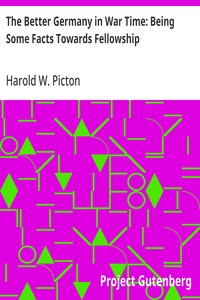
The Better Germany in War Time: Being Some Facts Towards Fellowship — Key Ideas to Explore
(0 User reviews)
3584
Project Gutenberg
2008
Not confirmed
World War, 1914-1918 -- Hospitals, charities, etc.; World War, 1914-1918 -- Prisoners and prisons, German
Readers of public-domain and historical texts
Project Gutenberg digital edition
en
Edition facts
Words
97,570
Reading time
425 min
Text sections
14
This digital edition of The Better Germany in War Time: Being Some Facts Towards Fellowship — Key Ideas to Explore is described by source-level measurements including 97,570 words, 7 hr 5 min estimated reading time, and 14 detected text sections.
The text analysis averages about 19.3 words per sentence, while the detected sections provide another way to judge how the source is divided.
Project Gutenberg metadata also associates the work with “World War, 1914-1918 -- Hospitals, charities, etc.,” connecting these edition facts with the source record’s subject description.
Source:
Project Gutenberg record #24810
Harold Picton's 1918 work counters wartime propaganda by documenting acts of German humanity—from prisoner welfare to civilian aid—through firsthand accounts and official reports, arguing for fellowship over hatred.
Read the complete public-domain text at its original source.
Read on Project GutenbergHarold Picton opens his 1918 work with a soldier’s suggestion for “a golden book” of enemy good deeds, directly challenging the dominant horror narratives of World War I. The book is structured as a deliberate counterweight, assembling evidence from multiple sources: official reports, letters, and personal testimonies. Picton’s subtitle, “Being Some Facts Towards Fellowship,” signals his argumentative purpose—not neutral reportage but a polemic for reconciliation. The epigraphs, including a Times Literary Supplement passage framing war as “civil war” and a warning from a chaplain that hatred “recoils on the hater,” establish the moral stakes. Picton writes from a specific position: a British author addressing both British and German peoples, dedicating the work to his mother who “knew and loved them both.”
The Foreword’s Framing of a Counter-Narrative
In the foreword, Picton explicitly states his method: “One kind of German has been too often described, and not infrequently invented. I propose here to describe the other German.” He does not deny atrocities but insists on documenting overlooked decency. The anecdote of the wounded soldier proposing a “golden book” serves as both origin story and rhetorical device. Picton acknowledges the difficulty of recognizing good in an opponent during war, yet he presses forward, collecting “materials already to hand.” This framing is crucial: the book is presented as an act of recovery, not invention. The foreword also includes a telling quotation from Lord Newton, who noted that any statement not accusing Germans of brutality risked being denounced as “pro-German.” Picton thus positions his work as swimming against a powerful current of public opinion.
Domestic Suffering and the Work of Relief Committees
Picton’s account of civilian prisoners in England offers a stark contrast to official propaganda. He describes visiting a German family in a basement room off Tottenham Court Road, where rats made sleep difficult and no fire was ever found. The wife, Bertha, explains they take turns staying in bed because “it’s warmer there and you don’t seem to feel so hungry.” Their income of 12s. 6d. weekly, with 6s. for rent, leaves no margin for coal or milk. Picton records the work of the Friends’ Emergency Committee and Dr. K. E. Markel, who provide material aid. Another family—Ludwig, an Austrian waiter, and his Irish wife Marie—live in two rooms with five children. Ludwig’s employer would rehire him “if only the public or the newspapers would let him.” Picton’s detail is precise: the doctor prescribed milk for Marie, but “the children must be fed first.” These vignettes personalize systemic hardship.
Prisoner Welfare and the Göttingen Camp Example
Picton devotes attention to the treatment of military prisoners in Germany, using the Göttingen camp as a case study. Professor Stange, who directs instruction there, attends daily, gives lectures, and supervises the library. A German newspaper complained that prisoners in Göttingen had “as good a time as if they were at a health resort.” Stange’s response is measured: “No internment camp can be compared with a ‘holiday resort.’” He insists that internment remains “a very hard lot.” Picton does not claim the camp was ideal, but he presents Stange’s work as evidence of humane effort within a flawed system. The passage illustrates Picton’s broader method: he selects specific, verifiable instances of German decency—here, an academic’s commitment to prisoner education—and lets them stand against generalized accusations. The tone is factual, not defensive.
Picton’s book is best read as a primary source on wartime humanitarianism and the politics of evidence. Readers should note his reliance on committee reports, personal letters, and published statements—each piece of testimony is offered as a counterweight to rumor. The work does not claim to be comprehensive; Picton calls it “very imperfect.” Its value lies in the specificity of its examples and the clarity of its moral argument: that fellowship, not hatred, is the only sustainable response to war. Those interested in the history of pacifism, prisoner advocacy, or Anglo-German relations will find here a deliberate, documented alternative to the dominant narratives of 1914–1918.
I remember when The Better Germany in War Time taught me that even in the darkest years, kindness slipped through the cracks. Years later, The New Germany — Reading Notes sat beside it on my shelf, and I felt that quiet kinship—two voices hoping the same gentle thing, across the decades.
There are no reviews for this eBook.
There are no comments for this eBook.
Reader reflection
What was your reading experience?
Capture what you thought, learned, and would like to remember.
Your progress
0
/
10
2
What was your overall reaction to the book?
3
Would you pass this book on to a friend?
4
How much effort did this book require?
5
Would you start a conversation about this book?
6
Could you follow the author’s main argument?
7
How did the pace of the book feel?
8
Could you see yourself revisiting this book?
9
What changed or sharpened your thinking?
10