1

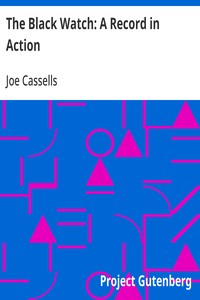
The Black Watch: A Record in Action — Background and Themes
(0 User reviews)
51
Project Gutenberg
2010
Not confirmed
World War, 1914-1918 -- Personal narratives, English; Great Britain. Army. Black Watch (Royal Highlanders)
Readers of public-domain and historical texts
Project Gutenberg digital edition
en
Edition facts
Words
51,758
Reading time
226 min
Text sections
5
The catalog record for The Black Watch: A Record in Action — Background and Themes provides practical reading context through 51,758 words, 3 hr 46 min estimated reading time, and 5 detected text sections.
The text analysis averages about 17.8 words per sentence, while the detected sections provide another way to judge how the source is divided.
Project Gutenberg metadata also associates the work with “World War, 1914-1918 -- Personal narratives, English,” connecting these edition facts with the source record’s subject description.
Source:
Project Gutenberg record #33278
A first-hand account by a Black Watch scout of the 1914 retreat from Mons, marked by stark, unadorned prose and vivid sensory details. The narrative shifts between weary humor and grim realism, capturing the soldier's perspective without heroic gloss.
Read the complete public-domain text at its original source.
Read on Project GutenbergJoe Cassells, a scout in the Black Watch, writes with a deliberate flatness that resists the grand rhetoric of official war histories. His account of the 1914 retreat from Mons is built from small, concrete observations: the taste of apple-and-plum jam, the weight of mud on a uniform, the sound of a comrade's name called out to check if he is wounded or dead. The foreword promises a tale 'of the war, not about the war,' and Cassells delivers by staying close to the sensory and the mundane, even as the situation turns desperate.
His prose moves in short, declarative sentences, often punctuated by abrupt shifts in tone. A moment of levity—discussing football league matches—is shattered by the orderly corporal's question about a missing man. This structural pattern, a sudden jerk from relief to dread, becomes the book's rhythmic signature.
Voice of the Ranks
Cassells writes as a soldier, not a professional author, and his language carries the cadence of spoken Scots dialect. Words like 'daud' (a lump) and 'muckin'-in' (sharing) appear without explanation, anchoring the narrative in a specific regimental culture. He refers to himself and his comrades as 'jocks,' a term used by English soldiers, and reproduces their banter: 'Down’t wish y’ enny ’arm—but ye’r gowin’ ta ’ave an ’ell of an ’ot tyme, you Jocks!' The effect is immediate and unpolished, as if the reader is overhearing a conversation in a billet.
This vernacular voice extends to his descriptions of emotion. Rather than stating fear, he notes physical reactions: 'I fell asleep sighing and wondering how soon it would be when my letters would find no claimant for them.' The indirectness is more powerful than any declaration of terror. The narrative is punctuated by small, telling details—the quarter-pound tin of Golden Flake cigarettes, the razor borrowed from a new arrival—that root the reader in the material reality of a soldier's life.
Pace and the Sudden Jerk
The book's pacing mirrors the unpredictability of trench life. Cassells repeatedly builds a scene of relative comfort—a rest day, a mail delivery, a shared meal—only to break it with a sharp command or an ominous sign. In one passage, the men are 'elevated a million feet in the air' by letters from home, then 'with a sudden “jerk”' they are brought back by news of a casualty. This structural device recurs throughout the excerpts, creating a rhythm of tension and release that feels authentic to the soldier's experience.
Movement is similarly abrupt. The battalion is told they will have 'a few days’ rest,' only to be roused that same night: 'Fall in at the double, men!' The march to the new trenches is described in terms of physical discomfort—'wading through mud,' 'grouching in the ranks'—and the journey takes three hours for what could have been covered in thirty minutes, a detail that underscores the chaos of the retreat. Cassells does not explain the strategic necessity; he simply records the fatigue and the grumbling.
Sensory Anchors in Chaos
Cassells relies heavily on smell, sound, and sight to convey the proximity of danger. He notes that 'my nostrils sensed that there must have been some killing going on in the vicinity' before he sees any evidence. The wrecked transport wagons and dead horses appear as visual proof of what the nose already knew. Later, the sight of a German sausage balloon 'brought back the memory of the heavy firing,' linking a distant object to past trauma.
These sensory details are never embellished. A concealed battery of howitzers is noted without comment; the cheering of English soldiers is reproduced verbatim. The effect is a kind of documentary realism, where the reader is placed inside the scout's perceptual field. Cassells does not interpret or moralize; he reports what he sees, smells, and hears. This restraint gives the narrative its authority, as if the act of recording itself is a form of survival.
Cassells's account is best read as a series of vignettes rather than a continuous narrative. The excerpts suggest that the book's power lies in its gaps—the moments of silence between orders, the unspoken thoughts behind a soldier's sigh. Readers should attend to what is left unsaid as much as what is recorded, and resist the urge to fill in the emotional blanks. The flatness of the prose is not a lack of feeling but a deliberate choice, a way of bearing witness without the comfort of hindsight.
Reading the scout’s weary humor amid the Mons retreat, I remembered my grandfather’s silence about the war—how he’d only say the mud was endless. That flat, unheroic honesty came back to me in The U-boat hunters — A Reader’s Guide, where the sea’s grey patience feels just as heavy, just as true.
There are no reviews for this eBook.
There are no comments for this eBook.
Reader reflection
What was your reading experience?
Capture what you thought, learned, and would like to remember.
Your progress
0
/
10
2
How much did you enjoy the reading experience?
3
Would you pass this book on to a friend?
4
Did the language feel accessible?
5
Did this book create an emotional response?
6
Did it raise ideas you would like to talk about?
7
How clear did the writing feel?
8
Was the book moving at the right speed?
9
What did this book teach you most?
10