1

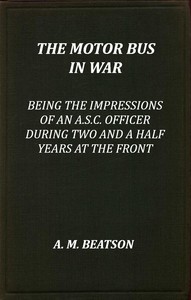
The motor-bus in war — Inside the Classic
(0 User reviews)
1400
Project Gutenberg
2014
Not confirmed
World War, 1914-1918 -- Personal narratives, English; World War, 1914-1918 -- Transportation
Readers of public-domain and historical texts
Project Gutenberg digital edition
en
Edition facts
Words
40,502
Reading time
177 min
Text sections
6
The source record for The motor-bus in war — Inside the Classic measures this digital text at 40,502 words, 2 hr 57 min estimated reading time, and 6 detected text sections.
The text analysis averages about 26.0 words per sentence, while the detected sections provide another way to judge how the source is divided.
Project Gutenberg metadata also associates the work with “World War, 1914-1918 -- Personal narratives, English,” connecting these edition facts with the source record’s subject description.
Source:
Project Gutenberg record #46283
A firsthand account by an A.S.C. officer of motor-bus transport behind the Western Front, focusing on supply chains, logistics, and the daily routines of non-combatant soldiers, with observations on French civilians and wartime administration.
Read the complete public-domain text at its original source.
Read on Project GutenbergBeatson’s narrative opens by distinguishing his work from the many frontline memoirs published during the war. He writes from the perspective of an Army Service Corps officer, describing the “vast organization behind the battle-line” that supplies food and ammunition. The book’s subtitle—being the impressions of an A.S.C. officer during two and a half years at the front—signals its focus on logistics rather than combat. Beatson explicitly addresses contemporary criticism about the size of rear-echelon forces, though he declines to argue the point at length. His tone is matter-of-fact, and he grounds his observations in specific routines: railheads, supply columns, motor-lorry convoys, and workshops. The excerpts reveal a writer attentive to the mundane yet essential machinery of war, from the condition of roads to the organization of rations.
The Rear Echelon as a Subject
Beatson positions his book as a corrective to the prevailing focus on trench fighting. He notes that most people at home imagine only the front-line trenches, “scarcely realizing the stupendous part in the war drama that is played by the men engaged in the vast organization behind the battle-line.” This is not a boast but a framing device: he intends to document the “long chain of transport, mechanical and animal, advanced supply depots, hospitals, rest camps” that connects the fighting army to its bases. The catalog subjects list World War, 1914-1918 – Personal narratives, English and World War, 1914-1918 – Transportation. The excerpts bear out the transportation focus, but the personal narrative is less about individual heroism than about systemic description. Beatson’s voice is that of a staff officer explaining how things work, not a combatant recounting danger. He refers to the men in the rear as “doing their bit somewhere in France,” a phrase that acknowledges their contribution without inflating it.
French Civilians and the War Effort
One of the more detailed passages in the excerpts describes the labor of French civilians. Beatson observes that “the work of the land, right up almost to the trenches, in this richly agricultural and intensely cultivated country, is carried on as usual by those left behind.” He notes the remarkable manual work done by “old men, women, and children,” and contrasts the low pay of the French soldier—five centimes a day, later raised to twenty-five—with the necessity that drives families to keep farms running. This observation is specific and grounded in the text, not a general reflection. Beatson also recounts an anecdote about a suspected spy: a Frenchman seen making notes as artillery passed. The man’s explanation—that he was trying to write a note to a woman he admired—is presented as a “curious mistake” from the early war. The story illustrates the tension between vigilance and paranoia, and Beatson tells it with a dry, understated humor.
Wartime Posters and Official Messaging
Beatson draws a pointed contrast between the proliferation of posters in England and the relative scarcity in France. The only ubiquitous French poster, he reports, contains three lines from the Minister of War: “Taisez-vous! Méfiez-vous! Les oreilles des ennemies vous écoutent!” He translates this as “Keep quiet! Be careful! The ears of the enemy are listening to you!” and praises its directness. The other posters he mentions advertise the French War Loan, which he compares favorably to London theatrical posters. This attention to visual propaganda is a small but telling detail: Beatson is as interested in the texture of daily life—what people see on walls, how they are addressed by authority—as in the mechanics of supply. The observation is precise and traceable to the text, and it reveals his eye for the incidental evidence of a society at war.
Beatson’s account is best read as a document of the logistical war, not a combat memoir. Readers interested in the daily workings of the A.S.C., the condition of French civilians under occupation, or the material culture of the Western Front will find specific, unadorned observations. The book’s value lies in its ordinariness: it records what a staff officer saw and thought worth noting, from the state of the roads to the posters on café walls. Approach it as a primary source for the history of military transport and rear-area life, rather than for dramatic narrative.
Reading the A.S.C. officer’s account, I kept thinking about the quiet weight of routine—how moving buses behind the lines becomes its own strange, ordinary war. It reminded me of the softer ache in War in the Garden of Eden — Context and Discussion, where the landscape itself remembers what the soldiers barely spoke of. That lingering feeling stays with you, like dust on a windscreen.
There are no reviews for this eBook.
There are no comments for this eBook.
Reader reflection
Take a moment to reflect on this book
Create a short personal record of your experience with this book.
Your progress
0
/
10
2
How much did you enjoy the reading experience?
3
Would you encourage someone else to read it?
4
What was the reading difficulty like?
5
How closely did the book connect with your experience?
6
How much did the book move you?
7
Could you apply anything you learned?
8
How understandable was the text?
9
What did this book teach you most?
10