1

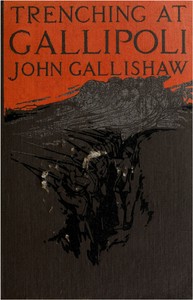
Trenching at Gallipoli The personal narrative of a Newfoundlander with the ill-fated Dardanelles expedition — Inside the Classic
(0 User reviews)
72
Project Gutenberg
2011
Not confirmed
World War, 1914-1918 -- Personal narratives, Canadian; World War, 1914-1918 -- Campaigns -- Turkey -- Gallipoli Peninsula
Readers of public-domain and historical texts
Project Gutenberg digital edition
en
Edition facts
Words
47,023
Reading time
205 min
Text sections
6
The source record for Trenching at Gallipoli The personal narrative of a Newfoundlander with the ill-fated Dardanelles expedition — Inside the Classic measures this digital text at 47,023 words, 3 hr 25 min estimated reading time, and 6 detected text sections.
The text analysis averages about 16.5 words per sentence, while the detected sections provide another way to judge how the source is divided.
Project Gutenberg metadata also associates the work with “World War, 1914-1918 -- Personal narratives, Canadian,” connecting these edition facts with the source record’s subject description.
Source:
Project Gutenberg record #35119
John Gallishaw's firsthand account of the First Newfoundland Regiment at Gallipoli focuses on trench slang, democratic relations between ranks, and the psychological coping mechanisms of soldiers under fire.
Read the complete public-domain text at its original source.
Read on Project GutenbergJohn Gallishaw's narrative opens with the stark announcement that 'Great Britain is at War,' a phrase that sets the tone for a personal account rooted in the specific experience of a Newfoundlander. The author immediately establishes his perspective as a member of the First Newfoundland Regiment, a colonial unit whose presence at Gallipoli was unprecedented. Rather than offering a strategic overview, Gallishaw immerses the reader in the daily realities of trench life, from the logistics of landing supplies to the informal hierarchies among soldiers. His attention to the vernacular of the trenches—terms like 'gun-fire' for morning tea and 'washout' for a fallen comrade—reveals a keen ear for the language that shaped morale and identity under fire.
The Vocabulary of Survival
Gallishaw devotes notable space to the slang that permeated the ranks, treating it as a window into the soldiers' mindset. He records that a Turk was never called a Turk but rather 'a Turkey, Abdul Pasha, or a cigarette maker,' and that a regiment was referred to as a 'mob.' The euphemisms for death are particularly telling: men who died had 'gone west,' been a 'washout,' or 'copped it.' A bullet wound from friendly fire was a 'dose of three-o-three,' referencing the bullet's caliber. These terms, Gallishaw suggests, served as psychological armor, allowing soldiers to distance themselves from the horror of loss. The author's decision to catalog this lexicon—rather than simply narrate events—demonstrates his interest in how language shapes experience. He presents the slang not as colorful decoration but as a functional tool for coping with the relentless pressure of the front lines.
Rank and Camaraderie
A recurring observation in the excerpts is the contrast between aloof junior officers and approachable senior commanders. Gallishaw notes that 'while the young subaltern lieutenants held themselves very much aloof, the senior officers chatted amiably with our men.' He specifically highlights General Sir Ian Hamilton, who 'visited the front line trenches and stopped to exchange a few words with men here and there.' The Newfoundlanders, described as 'democratic to the core,' resented any hint of 'side' and respected officers who shared their risks. This dynamic is illustrated in a scene where Gallishaw and a comrade encounter Hamilton and his aide; the general returns their salute 'smilingly,' prompting a conversation about trust and confidence. The author uses these interactions to explore the social fabric of the regiment, where respect was earned through shared danger rather than insignia.
Rituals Amid Ruin
Gallishaw juxtaposes the brutality of war with moments of improvised normalcy. One striking passage describes a Sunday service conducted by a soldier named Stenlake in an empty dugout. As Stenlake leads a prayer, Turkish batteries open fire, yet the service continues. The author frames this not as heroism but as a 'simple, sincere' act of defiance against chaos. Elsewhere, he depicts the beach transformed into a logistical hub, with 'dugouts of all sorts,' piles of rations, and a graveyard fenced off by Australians. These details underscore the soldiers' effort to impose order on a landscape of constant threat. The service, interrupted by shelling, becomes a microcosm of the trench experience: a fragile routine maintained in the face of imminent violence. Gallishaw's understated tone allows the scene to speak for itself, avoiding melodrama while emphasizing the resilience of ritual.
The Landscape of Logistics
The author's descriptions of the physical environment are grounded in the practicalities of supply and movement. He notes the 'mule path that led along the edge of the Salt Lake to West Beach,' and the transformation of the landing area into a bustling depot with 'piers built for the landing of supplies and troops.' The beach is stacked with 'boxes of beef, biscuits, jam, lime juice, and rum,' while medical facilities are tiered from a temporary dressing station to a clearing station and finally to hospital ships offshore. This attention to infrastructure reveals the war as a matter of logistics as much as combat. Gallishaw's eye for detail—the wire fence around a graveyard, the 'beetling cliffs' sheltering dugouts—grounds the narrative in a specific, tangible place. He conveys the Gallipoli peninsula not as a mythical battlefield but as a cramped, improvised encampment where survival depended on the steady flow of material.
Readers approaching Trenching at Gallipoli should attend to Gallishaw's deliberate choices in diction and structure. His focus on slang, rank dynamics, and logistical detail offers a ground-level view of war that resists grand narratives. The narrative's episodic quality—moving from a prayer service to a description of beach supplies—mirrors the fragmented nature of trench life. By limiting himself to what he witnessed, Gallishaw provides a document that is both personal and representative, a record of how one soldier made sense of the absurdity and danger of the Dardanelles campaign.
I’ve often thought how Gallishaw’s lads, scrabbling in the chalky trenches, found kinship in shared slang—much as the weary gunners of the Eleventh found their own quiet words in the mud. It’s not the glory, but the small, tired jokes that bind them. In both, the true story lives between the lines. The Delta of the Triple Elevens — Inside the Classic carries that same ragged warmth, like a hand on a shoulder in the dark.
There are no reviews for this eBook.
There are no comments for this eBook.
Reader reflection
Before you leave, reflect on the book
Use these questions to collect your thoughts before moving on.
Your progress
0
/
10
2
Was reading this book enjoyable?
3
Is this a title you would suggest to others?
4
How demanding did the text feel?
5
Do you expect to return to this book?
6
Did the book offer a fresh perspective?
7
Which aspect of the book did you value most?
8
How personally connected did you feel to the book?
9
What is the main idea you are taking away?
10