1

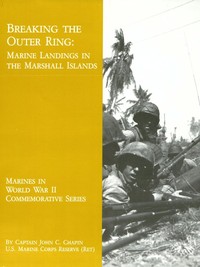
Breaking the Outer Ring: Marine Landings in the Marshall Islands — Reading Notes
(0 User reviews)
1251
Project Gutenberg
2015
Not confirmed
United States. Marine Corps -- History -- World War, 1939-1945; World War, 1939-1945 -- Campaigns -- Marshall Islands
Readers of public-domain and historical texts
Project Gutenberg digital edition
en
Edition facts
Words
17,853
Reading time
78 min
Text sections
17
For Breaking the Outer Ring: Marine Landings in the Marshall Islands — Reading Notes, the stored edition analysis reports 17,853 words, 1 hr 18 min estimated reading time, and 17 detected text sections.
The text analysis averages about 19.9 words per sentence, while the detected sections provide another way to judge how the source is divided.
Project Gutenberg metadata also associates the work with “United States. Marine Corps -- History -- World War, 1939-1945,” connecting these edition facts with the source record’s subject description.
Source:
Project Gutenberg record #48898
This editorial note examines how John C. Chapin's account of the 1944 Marshall Islands campaign uses specific language, structure, and recurring details to guide a first reading, focusing on the opening, middle, and later excerpts.
Read the complete public-domain text at its original source.
Read on Project GutenbergJohn C. Chapin opens Breaking the Outer Ring by framing the Marshall Islands as a strategic unknown: mandated to Japan after World War I, barred to outsiders, and presumed to contain illegal fortifications. The phrase “source of mystery and speculation” sets a tone of uncertainty that the narrative will resolve through detailed operational accounts. The opening also establishes a chain of command—from the Combined Chiefs of Staff to Admiral Nimitz—that reappears in sidebars and tactical descriptions, giving the reader a clear hierarchy to follow.
The Opening: Mystery and Command Structure
The first excerpt immediately positions the Marshalls as a “source of mystery and speculation,” a phrase that primes the reader for a campaign defined by unknowns. Chapin then anchors this mystery in a concrete planning history: a Marine officer had pinpointed the islands’ significance as early as 1921. This move from vague threat to specific precedent is a pattern repeated throughout the text. The opening also introduces the command structure in a single sentence—Nimitz’s titles are given in full—which signals that the reader should pay attention to who gives orders and who executes them. Sidebars on Major Generals Smith and Schmidt reinforce this emphasis on leadership.
Middle Excerpts: Tactical Detail and Human Incident
In the middle of the text, Chapin shifts from planning to the assault on Roi-Namur and Kwajalein. Here the prose becomes granular: a Japanese officer “squirting a fire extinguisher” at a flamethrower, a Marine carrying palm branches for camouflage, the precise count of 8,122 Japanese deaths versus American losses. These details are not merely colorful; they serve as evidence for the tactical innovations Chapin lists—first use of underwater demolition teams, DUKWs, command ships, and armored amphibian tractors. The reader is guided to see each incident as part of a larger pattern of adaptation. The inclusion of Medal of Honor citations for individuals like LtCol Aquilla J. Dyess and PFC Richard B. Anderson personalizes the statistics without romanticizing them.
Later Excerpts: Innovation and Aftermath
The later excerpts consolidate the campaign’s lessons. Chapin enumerates “first use” innovations in a bullet-like list, each tied to a specific battle: the first use of Navy underwater demolition teams, the first use of DUKWs in combat, and so on. This list functions as a summary for the reader, but it also points forward—these innovations would be used in the Marianas and beyond. The text then notes that Kwajalein would become a base for B-29 raids, linking the Marshall Islands campaign to the broader Pacific war. The final excerpt includes a sidebar on “The Deadly Spider Holes,” a term that recurs in Marine accounts of Japanese defensive positions, and a commendation from the Secretary of the Navy, which serves as an official endorsement of the actions described.
Recurring Details: Sidebars and Statistics
Throughout the excerpts, Chapin uses sidebars to isolate key figures and concepts: Major General Holland M. Smith, Major General Harry Schmidt, the 4th Marine Division, Brigadier General Thomas E. Watson, and the “Deadly Spider Holes.” These sidebars break the narrative flow but provide essential context for readers unfamiliar with Marine Corps organization. Statistics are another recurring detail—Japanese deaths “27 times the number of Americans killed”—that Chapin presents without commentary, letting the numbers speak. The ratio is striking, and its placement at the end of the Kwajalein section gives the reader a moment to reflect before moving to Eniwetok. The sidebars also include photographs with captions that identify specific units and equipment, grounding the text in visual evidence.
Readers approaching Breaking the Outer Ring for the first time will benefit from noting how Chapin alternates between broad strategic context and narrow tactical vignettes. The sidebars are not interruptions but essential glosses on the main text. Pay attention to the dates and place names: the campaign moves from Roi-Namur to Kwajalein to Eniwetok, each island presenting different challenges. The innovations listed in the later excerpts are the payoff for the planning described in the opening. This is a work of official history, but its strength lies in the concrete details that make the abstract campaign tangible.
Years between them whisper the same story, though the waters differ. Chapin’s Marines pressing against coral and steel, and that older raid’s desperate harbour blockade, both speak of men who chose the nearer shore. In my quiet stacks, their binding holds a shared loneliness—the careful waiting, the sudden roar, the sea’s indifference. The Blocking of Zeebrugge — Reading Notes feels like a familiar echo from a louder generation. I often shelve them side by side.
There are no reviews for this eBook.
There are no comments for this eBook.
Reader reflection
Before you leave, reflect on the book
Use these questions to collect your thoughts before moving on.
Your progress
0
/
10
2
Was reading this book enjoyable?
3
How likely are you to recommend this book?
4
What was the reading difficulty like?
5
How did the pace of the book feel?
6
How distinctive were its ideas or approach?
7
Did the book give you something worth debating?
8
Did the book meet your expectations?
9
What is the main idea you are taking away?
10