1

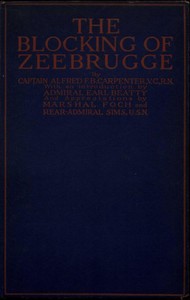
The Blocking of Zeebrugge — Reading Notes
(0 User reviews)
1978
Project Gutenberg
2014
Not confirmed
World War, 1914-1918 -- Naval operations, British; Zeebrugge-Ostend Raids, 1918
Readers of public-domain and historical texts
Project Gutenberg digital edition
en
Edition facts
Words
77,713
Reading time
338 min
Text sections
10
This digital edition of The Blocking of Zeebrugge — Reading Notes is described by source-level measurements including 77,713 words, 5 hr 38 min estimated reading time, and 10 detected text sections.
The text analysis averages about 20.6 words per sentence, while the detected sections provide another way to judge how the source is divided.
Project Gutenberg metadata also associates the work with “World War, 1914-1918 -- Naval operations, British,” connecting these edition facts with the source record’s subject description.
Source:
Project Gutenberg record #45718
Captain Carpenter's firsthand account of the 1918 Zeebrugge raid details the meticulous planning, timing, and execution of a complex naval operation, emphasizing authorial choices in diction and description that convey the tension and precision required.
Read the complete public-domain text at its original source.
Read on Project GutenbergCaptain A. F. B. Carpenter, who commanded the assault on the Zeebrugge Mole, writes with the clipped authority of a naval officer accustomed to precision. His prose mirrors the operation's own logic: every sentence seems timed, every detail placed with purpose. The book opens not with dramatic flourish but with a technical problem—how to synchronize over 150 vessels without radio signals that would betray surprise. Carpenter's solution, a prearranged timetable, becomes the narrative's backbone, and his language reflects this mechanical exactitude. He speaks of 'the timing question' as a puzzle to be solved, not a story to be told.
The Language of Synchronization
Carpenter's diction repeatedly foregrounds coordination over heroism. He writes of 'the necessity for the monitors to take up independent positions' and 'the line of fire from the bombarding vessels' as logistical constraints, not tactical choices. The word 'synchronisation' appears with clinical frequency. When he describes the interval between the storming vessels and blockships—'twenty minutes'—he treats it as a variable to be optimized, not a dramatic countdown. This vocabulary of engineering (timing, calculation, synchronisation) shapes the reader's sense of the raid as a mechanical problem rather than a romantic charge. Even the enemy is depersonalized: German defenses 'recover from the initial surpri' (the text cuts off), but the focus remains on the British timetable, not the human cost.
Voice and Authority: The First-Person Plural
Carpenter consistently uses 'we' and 'our'—'we would not be satisfied with the degree of punctuality usually associated with certain railways'—creating a collective, institutional voice. This is not the memoir of a lone hero but the report of a commander speaking for his force. The pronoun choice implies shared responsibility and shared risk. When he notes that 'every unit should know, at a late stage of the oversea trip, if the blockships were likely to be late,' the 'we' absorbs the reader into the planning room. This rhetorical strategy reinforces the operation's collaborative nature and downplays individual glory, aligning with the book's stated purpose: to explain the military reasons behind the raid, not to celebrate personal valor.
The Texture of Detail: Concrete Obstacles
Carpenter grounds abstract planning in tangible specifics. He mentions 'aerial bombers flying at a hundred miles per hour' versus ships 'steaming at about one-tenth of that speed'—a ratio that makes the coordination problem visceral. He worries about 'vagaries of the tidal stream' and the 'unwieldiness of a fleet comprising over one hundred and fifty vessels.' These details are not decorative; they are the raw material of his argument that the operation required 'foresight and exactitude.' The reader learns that the storming vessels were to arrive twenty minutes ahead of the blockships, and that this interval was chosen to prevent the German defenses from 'recover[ing] from the initial surpri'—a fragment that hints at the razor-edge timing. Such specifics give the narrative a documentary weight, as if Carpenter is annotating a blueprint rather than recalling a battle.
Structure as Argument: From Problem to Solution
The book's opening chapters follow a logical progression: first establishing the strategic necessity (the submarine threat), then the tactical problem (how to block the canal), then the operational challenge (timing). Carpenter presents each phase as a question to be answered: 'How could a satisfactory synchronisation of events be arranged?—that was the problem.' He then dismisses alternatives—signals would 'make our presence known'—before settling on the timetable method. This problem-solution structure mirrors the planning process itself, making the narrative feel like a staff briefing. The prose is lean, almost instructional: 'Recourse was had to the time-table method.' There is no rhetorical flourish, only the steady accumulation of reasoning. The effect is to persuade the reader that the raid's success was a product of method, not luck.
Carpenter's account rewards readers who attend to process over drama. His focus on the 'timing question' and the mechanics of coordination offers a rare view of how a complex military operation was conceived on paper before it was executed at sea. The book's value lies not in battle scenes but in the patient, almost bureaucratic unraveling of a problem. For those interested in the craft of command—how decisions are made under constraints of time, tide, and silence—this is a precise and understated document.
That rainy afternoon, Carpenter’s insistence on the raid’s precise timing lingered with me long after I closed the book—the way a single misjudged wave could undo everything. I found myself thinking about discipline under pressure, which oddly led me to The Black Watch: A Record in Action — Background and Themes. Perhaps it wasn’t so strange; both are quiet testaments to men holding their nerve when the moment demanded it.
There are no reviews for this eBook.
There are no comments for this eBook.
Reader reflection
Record your reading impressions
A brief reflection can help important ideas stay with you longer.
Your progress
0
/
10
2
Was reading this book enjoyable?
3
Would you recommend this book to another reader?
4
What was the reading difficulty like?
5
How strongly did the book affect you emotionally?
6
How closely did the book connect with your experience?
7
Could you see yourself revisiting this book?
8
How distinctive were its ideas or approach?
9
In one sentence, what did you learn?
10