1

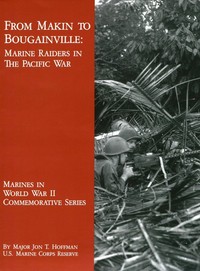
From Makin to Bougainville: Marine Raiders in the Pacific War — Inside the Classic
(0 User reviews)
334
Project Gutenberg
2015
Not confirmed
World War, 1939-1945 -- Campaigns -- Pacific Area; United States. Marine Corps. Marine Raider Regiment, 1st -- History; World War, 1939-1945 -- Amphibious operations
Readers of public-domain and historical texts
Project Gutenberg digital edition
en
Edition facts
Words
29,579
Reading time
129 min
Text sections
27
From Makin to Bougainville: Marine Raiders in the Pacific War — Inside the Classic can be approached with a clearer sense of reading commitment from its source measurements: 29,579 words, 2 hr 9 min estimated reading time, and 27 detected text sections.
The text analysis averages about 18.9 words per sentence, while the detected sections provide another way to judge how the source is divided.
Project Gutenberg metadata also associates the work with “World War, 1939-1945 -- Campaigns -- Pacific Area,” connecting these edition facts with the source record’s subject description.
Source:
Project Gutenberg record #48811
Examines the creation, operations, and dissolution of Marine Raider battalions in the Pacific, focusing on structure, leadership, and amphibious tactics from Makin to Bougainville.
Read the complete public-domain text at its original source.
Read on Project GutenbergThe narrative opens by framing the raiders not merely as a tale of combat heroics but as a lens into the Marine Corps’ wartime expansion from 19,000 to nearly half a million men. Hoffman immediately signals that the unit’s inception, growth, and sudden end reveal deeper currents in amphibious doctrine and organizational challenge. The text moves briskly from the February 1942 order creating the 1st Raider Battalion to the strong personalities—Edson, Carlson—who shaped the force. This editorial note traces how the work’s structure, recurring images, and movement between scenes build a portrait of an elite unit grappling with its own identity amid the larger machinery of war.
Structure as Argument
The pamphlet’s organization mirrors the raiders’ own trajectory: creation, shaping, getting to the fight, then a sequence of named battles—Makin, Tulagi, Tasimboko, Edson’s Ridge, Matanikau, the Long Patrol, New Georgia, Enogai, Bairoko, Bougainville. This is not a simple chronology; each chapter title functions as a waypoint in an argument about how elite units are formed, tested, and eventually absorbed. The sidebars—on Edson, Carlson, destroyer transports, weapons, the Raider Training Center, the Raider patch—act as structural parentheses, pausing the narrative to examine key components without breaking the forward momentum. The effect is a layered account where operational history and institutional analysis coexist.
Recurring Images of Movement and Surprise
Throughout the excerpts, movement is the dominant sensory experience: patrols moving forward, crossing ridgelines, entering bivouac sites, pulling back to base camps. The text repeatedly describes units that “tangled with another enemy group coming in the opposite direction” or “ran into yet another group of enemy.” Surprise is mutual—Marines and Japanese alike are caught off guard. The image of Corporal John Yancey charging into a bivouac site “firing his automatic weapon and calling for his squad to follow” crystallizes the raiders’ aggressive mobility. Even the enemy’s arms are “stacked out of reach,” a detail that underscores the suddenness of contact. These recurring scenes of encounter and disengagement create a rhythm of tension and release.
The Landscape as a Character
Geography is not backdrop but active force. The text traces movements through specific terrain: the Tenaru and Lunga river valleys, the “steep ridgeline” dividing them, the woods at Asamama, the beach at Koiari. Native scouts appear as crucial intermediaries, reporting enemy outposts. The landscape dictates tactics—Carlson divides his battalion into three combat teams operating from separate patrol bases, each day moving “farther into the interior.” The discovery of a telephone wire leads to a large bivouac site; the removal of key parts from an unattended 75mm mountain gun and scattering them “down the hillside” is a small but vivid instance of terrain being used offensively. The setting is never merely described; it is navigated, exploited, and contested.
Voice and the Documentary Impulse
Hoffman’s prose is lean, favoring concrete verbs and specific numbers: “25 of them,” “75,” “two killed and one wounded.” The tone is clinical but not cold; it trusts the facts to carry weight. The authorial voice rarely editorializes, yet the selection of details—Carlson calling Yancey’s charge “the most spectacular of any of our engagements”—allows participants to speak. The text also acknowledges gaps: “There is more to the story… than a simple tale of combat heroics.” This documentary impulse extends to the sidebars, which catalog equipment, training, and the patch insignia, grounding the narrative in material culture. The result is a history that feels both authoritative and intimate, built from the ground up.
Readers will find that the pamphlet rewards attention to its architecture: the way sidebars interrupt and amplify the main narrative, the repeated patterns of movement and surprise, the precise rendering of terrain. Hoffman’s account is less a celebration than an examination—of how an elite unit was conceived, tested, and ultimately reshaped by the demands of a global war. The work stands as a compact case study in military adaptation, best approached not as a linear story but as a network of interrelated observations about leadership, organization, and the physical realities of combat in the Pacific.
That rainy afternoon with From Makin to Bougainville left me thinking about men landing on strange shores, officers reading the surf wrong, the weight of salt and orders. Hours later, I found myself pulling down an old narrative about Gallipoli, another series of landings gone sideways. The mud and trenches felt closer to those Raider beaches than I expected. Trenching at Gallipoli The personal narrative of a Newfoundlander with the ill-fated Dardanelles expedition — Inside the Classic sat beside my tea, a quieter echo of the same troubled question. I didn’t plan it. It simply happened, the way good reading often does.
There are no reviews for this eBook.
There are no comments for this eBook.
Reader reflection
Before you leave, reflect on the book
Use these questions to collect your thoughts before moving on.
Your progress
0
/
10
2
Was reading this book enjoyable?
3
Would you recommend this book to another reader?
4
Did the language feel accessible?
5
Would this book work well in a reading group?
6
Which element worked best for you?
7
Was the book easy to understand?
8
Did anything about the book feel genuinely new?
9
What did this book teach you most?
10