1

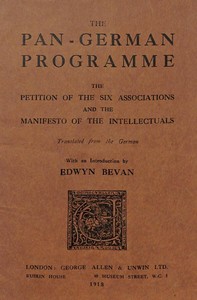
The Pan-German Programme The Petition of the Six Associations and the Manifesto of the Intellectuals — A Reader’s Guide
(0 User reviews)
76
Project Gutenberg
2014
Not confirmed
World War, 1914-1918 -- Peace; Pangermanism
Readers of public-domain and historical texts
Project Gutenberg digital edition
en
Edition facts
Words
11,870
Reading time
52 min
Text sections
3
Before opening The Pan-German Programme The Petition of the Six Associations and the Manifesto of the Intellectuals — A Reader’s Guide, the edition data offers a quick orientation: 11,870 words, 52 min estimated reading time, and 3 detected text sections.
The text analysis averages about 30.2 words per sentence, while the detected sections provide another way to judge how the source is divided.
Project Gutenberg metadata also associates the work with “World War, 1914-1918 -- Peace,” connecting these edition facts with the source record’s subject description.
Source:
Project Gutenberg record #46192
Edwyn Bevan's 1918 translation of two 1915 Pan-German documents reveals the annexationist war aims of German nationalist associations and intellectuals, including demands for French territory, Belgian control, and Russian land, with a translator's introduction contextualizing their political pressure on the German government.
Read the complete public-domain text at its original source.
Read on Project GutenbergThis pamphlet, translated and introduced by Edwyn Bevan in 1918, presents two documents that crystallize the maximalist war aims of the Pan-German movement during World War I. The first is a memorandum from six nationalist associations, submitted privately to Chancellor Bethmann Hollweg in May 1915; the second is a more expansive manifesto signed by 1,341 intellectuals, diplomats, and officials, circulated as a confidential manuscript the following month. Bevan's introduction frames these texts as responses to rumors of a compromise peace, showing how organized pressure groups sought to steer German policy toward territorial annexation and economic domination.
Two Documents, Distinct Scopes
The volume contains two separate but related texts. The Petition of the Six Associations, drafted in March 1915 and finalized on May 20, represents the demands of industrial and agrarian interests—especially the Rhenish-Westphalian ironmasters who coveted the French iron districts of Briey and Longwy. Its language is concrete and territorial, calling for annexations from France and Belgium and colonial expansion. The Intellectuals' Manifesto, read on June 20, 1915, at the Artists' Hall in Berlin, goes further by endorsing the Mitteleuropa scheme and German control over the Ottoman Empire, envisioning a belt of power from the North Sea to the Persian Gulf. Bevan notes that the Associations said nothing of this broader design, highlighting a strategic difference in scope between economic and ideological factions.
Annexationist Logic and Population Control
The documents articulate a vision of German expansion justified by security, demography, and economic autarky. Regarding France, the Associations demand that "the most important business undertakings and estates must be transferred from anti-German ownership to German hands," with the annexed population granted "absolutely no influence in the Empire." Belgium is to be held for political, military, and economic reasons, with the Flemish element expected to "remember its Teutonic affinities." The eastern frontier is framed as a demographic threat: Russia's population growth of 2.5 to 3 million yearly is called "the greatest danger to the German and European future," requiring agricultural land for German colonisation to produce "healthy peasants" and counter industrialisation. These passages reveal a racialised logic of Lebensraum before the term became infamous.
Bevan's Editorial Framing
Edwyn Bevan, a British scholar, provides a brief introduction that situates the documents within wartime politics. He explains that the Pan-German party was "very strong among the country landowners, i.e. the class called Junkers, and the rich manufacturers," but weak among workers and radical intellectuals. His account of the documents' secret circulation—the Intellectuals' Manifesto was submitted as a "strictly confidential manuscript" and suppressed after 1,341 signatures—emphasises the tension between public opinion and elite pressure. Bevan does not comment on the morality of the demands, but his selection and translation make the annexationist programme accessible to an English-speaking audience, serving as a primary source for understanding German war aims as they were formulated in 1915.
Language of Domination
The rhetoric of the documents is notable for its bluntness. The Associations state that "we must have no mercy upon France, however terrible the financial losses her own folly and British self-seeking have already brought upon her." The Intellectuals' Manifesto similarly treats conquered populations as obstacles to be managed, not as peoples with rights. The repeated phrase "transferred from anti-German ownership to German hands" functions as a euphemism for expropriation. The documents also reveal a preoccupation with internal stability: annexed territories must be prevented from creating "conditions such as those in Alsace-Lorraine," implying that the existing German administration of that region was seen as a cautionary example. This language of control, rather than liberation, distinguishes these texts from Allied propaganda about German war aims.
Readers should approach these documents as artifacts of a specific political moment—mid-1915, when German military momentum had stalled and factions within the elite competed to define war aims. Bevan's translation preserves the bureaucratic and legalistic tone of the originals, which can make the radical content seem matter-of-fact. Comparing the two texts reveals how different interest groups (industrialists versus intellectuals) prioritised different forms of expansion. The pamphlet is best read alongside histories of the Pan-German League and the wartime debate over annexations, as it offers raw material rather than analysis.
Reading Bevan’s notes on those 1917 petitions, I found myself thinking of another wartime voice—quieter, more hopeful. There is a strange comfort in remembering that even then, some Germans sought fellowship rather than conquest. That thread led me to The Better Germany in War Time: Being Some Facts Towards Fellowship — Key Ideas to Explore, which felt like a lantern in that dark room.
There are no reviews for this eBook.
There are no comments for this eBook.
Reader reflection
Take a moment to reflect on this book
Create a short personal record of your experience with this book.
Your progress
0
/
10
2
How much did you enjoy the reading experience?
3
Would you recommend this book to another reader?
4
What was the reading difficulty like?
5
How did the reading compare with what you expected?
6
Would you like to discuss this book with someone?
7
How did the pace of the book feel?
8
What was its emotional impact?
9
Which lesson or insight stayed with you?
10